Category: CONTENTS
-

How to make proposals in sociocracy
Picture forming and proposal shaping in an example to know how to make proposals in sociocracy – Sociocracy For All
-
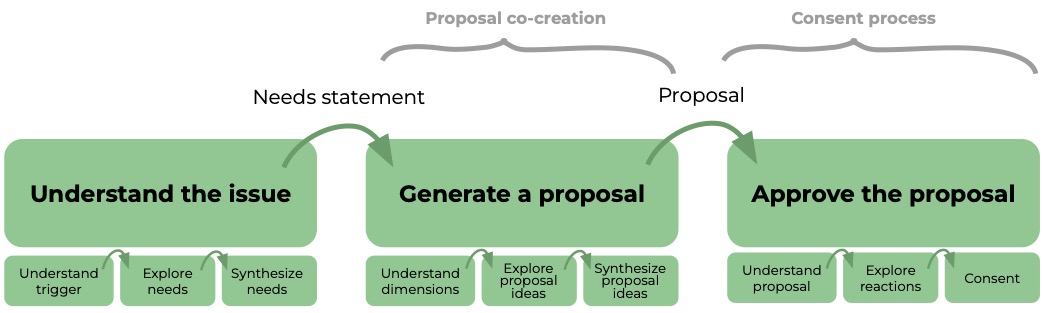
Participatory proposal writing
Picture forming, proposal shaping and synthesis – a 3-step process to turn everyone’s ideas into a good proposal!
-
Denmark Technical University DTU
IT department of 45 people, embedded in a typical hierarchical IT organization of 190 employees, delivering IT-services and software development to the Universities 6000 employees and 12000 students.
-
Intentional feedback in organizations
Intentional feedback is important to improve what we do in an organization. And feedback comes in all kinds of forms. For example, if we ride a bike, we need to check on our data frequently enough to be able to steer successfully. We can’t just look at the map as we get started and then…
-
Peer feedback process
—
by
Performance reviews (or “Role Improvement”) are a way to give feedback to one person or each other in a space of psychological safety.
-
On interpersonal feedback
—
by
There is no right and wrong Many people are afraid of feedback. “Can I give you some feedback?” is typically followed by criticism, and we don’t do well with criticism. When we face criticism, the most typical reaction is to shut down, get reactive, defensive or withdraw. If you want your feedback to be heard,…
-
The liberating effect of “good enough for now”
“Good enough” sounds like a low-level decision-making method. And yet, for some people, that’s not how they experience it. “Only” aiming for good enough can be a matter of respect and
-
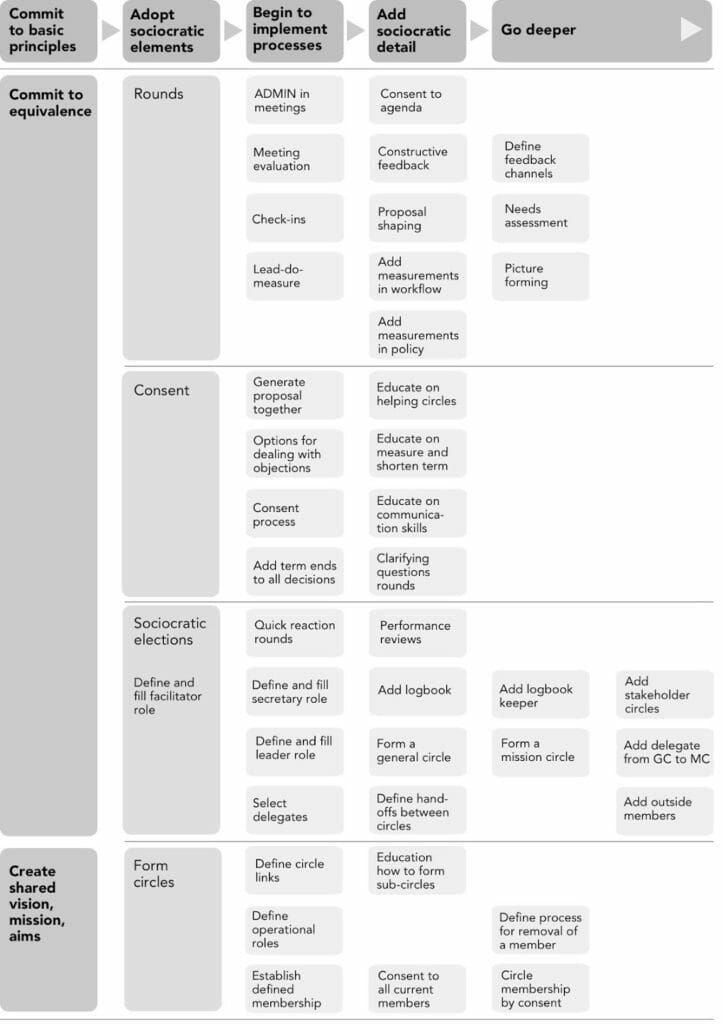
How to implement sociocracy – a roadmap
So, you want to implement sociocracy, but don’t know where to start? After gaining some basic knowledge, the next steps aren’t always clear. We’re here to help you out. First of all, let me say that I don’t believe in a cookie-cutter method. Every organization is a little different. And every organization has its unique…
-
Strategies for integrating objections
Integrating objections – how to Integrating objections is one of the core pieces of sociocracy. By integrating objections skillfully, concerns turn into a constructive force to improve your organization. This can be on the interpersonal level, on the level of the organization’s culture, or on the content level of your operations. As you cultivate more…
-
The Collaboration Superpowers – No One Is Ignored With Sociocracy
What’s special about Jerry Koch-Gonzalez’s meetings is that they are sociocratic. How often have you been part of a call where one person in the group hardly had any chance to speak?