Welcome!
This basic sociocracy introduction self-study course walks you through the basics of sociocracy.
We’re happy to have you!
Beginning to learn sociocracy can be confusing. It’s a lot at once.
We think it’s a little like learning to swim.
“I’m supposed to do my arms like this and my arms like that AND breathe? I’ll never learn that!”
If you know how to swim, ride your bike, or drive, or any of the things that seem impossible at first and then become normal once you have learned them, then be assured: sociocracy is just like that. It becomes second nature.
Once it’s all habit and muscle memory, you can focus on where you want to go. Sociocracy is your how.
This free sociocracy introduction takes about 75 min.
You can pause anytime and go back.

Unit 1
Why sociocracy?
Before we jump into the sociocracy introduction, let’s ground ourselves in the why.
Why does sociocracy even matter?
Read the transcript instead:
Introduction and history
Hello. My name is Ted Rau, and I’m part of Sociocracy For All. This is a video to give you a sociocracy introduction. The first thing we’re going to talk about is what governance is. The way I look at it, governance is basically what connects people and the project. If you only had people, you would not have an organization. Everybody would run in a different direction, and the work obviously needs people to do it. Governance is the set of rules and the set of principles and practices that connects the people with each other and with the work.
Sociocracy is a word that you know both parts of; you know the word sociology, and you know the word democracy. It is really the combination of these two words—those who associate together govern. In a simple way, one could say, “Those who do things together should decide,” instead of the masses voting or the boss deciding. Those who do the work should be the ones who decide. The principles of sociocracy, the way we still use them today, were put together in the late 1970s by Gerard Endenburg, an engineer who learned from Quaker decision-making, decision-making by consensus, natural systems, and cybernetics. All of those pieces are things that we find in sociocracy today.
Basic principles of governance systems and sociocracy
Now, any governance system needs to make a few basic choices. The first one is: how do we decide who decides what? In sociocracy, what we aim to do is make as many decisions as possible by the people who do the work, which means we need to distribute decision-making and authority into the hands of many people. How we do that is the question. There’s a pattern language or principles in sociocracy that allow us to do that. We form sub-circles by consent, so that in the end, we have a set of teams that make all of the decisions in a distributed manner.
The second part of any governance system is: how do we decide? We could have a decision-making system where just one person makes all the decisions, but if we want to make decisions together, we need to figure out how to do that. We could vote, we could talk until we all agree, or we could use something else. In sociocracy, the decision-making method used for all the fundamental decisions—policy decisions—is consent. I will explain what that means better later. But for now, let’s just use it as the unifier, the thing that harmonizes everything and ensures that we stay on track. That is the intention of the decision-making method.
The last key component is feedback and continuous improvement. What we want is for any system to self-repair and become better over time. So, we need to put practices and processes in place so that the system itself can improve. A simple example is to stipulate that every meeting ends with a meeting evaluation, so that meetings themselves can be improved, because we learn from each other what could have been done better.
Alignment and autonomy in organizations
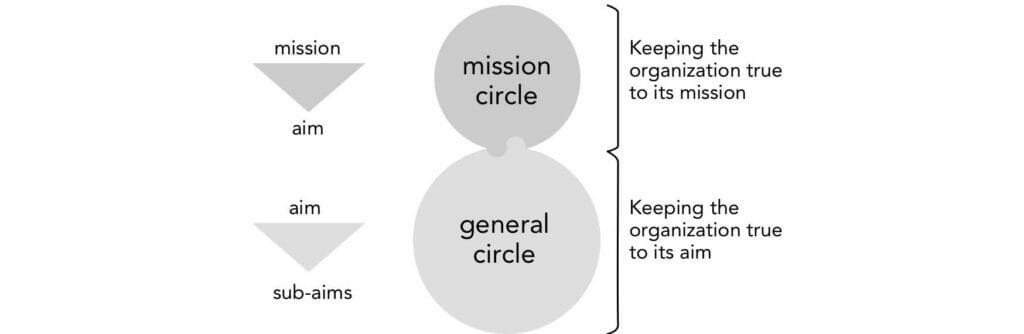
Then, in any organization, there are different dynamics at work, and all of them are interesting to look at. If you have a set of people who want to do things together, a set of individuals, they are not a team yet, or at least not in a sociocratic sense. In sociocracy, we want circles that are truly aligned. To turn a set of individuals into a circle that works together, we must define the aim of what they are doing together. While everyone may be running in different directions, the aim catches them and holds them together, keeping them aligned with each other and with the higher purpose of why they even exist.
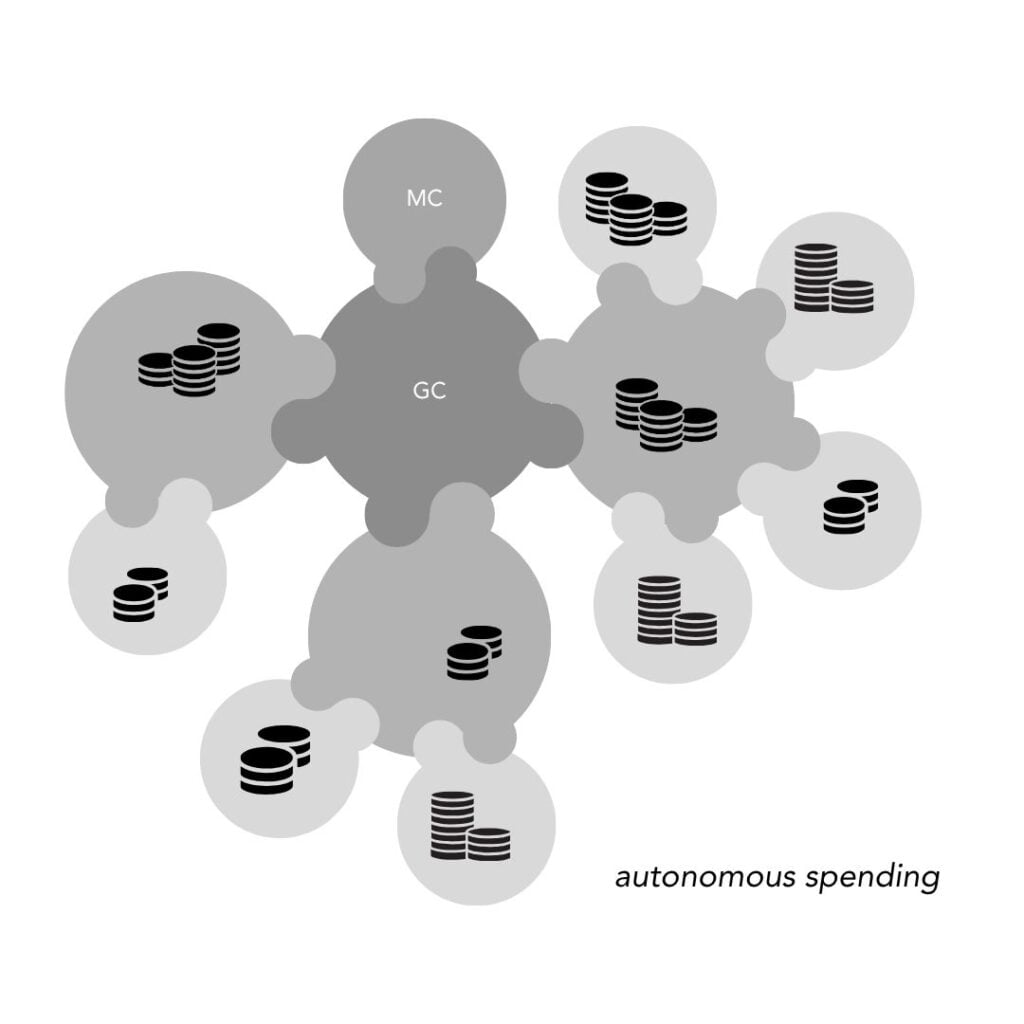
The same dynamic happens in an organization, which is basically a team of teams and individual roles. All the teams may be running in different directions, and then it’s the organizational governance and the aim that hold everything together. Both dynamics are important. The outward motion, which represents autonomy and a lot of agency, is great. But we also need coherence and alignment so that everything goes together. These are the two forces we need to keep in balance to have a good governance system.
Session overview
I will go through all of these different parts. This was my introduction to what sociocracy is and why it exists. We will look more into the details, including decision-making by consent, the circle structure and meeting format, feedback as a general principle, and how it plays out, as well as leadership and accountability.

Unit 2
How do we decide? Consent decision making
Group decision-making made easy!
Read the transcript instead:
Consent for policy decisions
In sociocracy, consent is the decision-making method used for all policy decisions. Before diving into the details of consent, it’s helpful to compare it to other decision-making methods that are commonly known. These include autocratic decisions, majority vote, and consensus. Understanding these methods provides a foundation for appreciating how consent works and why it’s effective in sociocratic governance.
Autocratic, Majority Vote, and Consensus
Autocratic Decisions: In autocratic decision-making, one person, like a king or a boss, decides without input from others. The major problem here is that the voices of others aren’t heard, and important information can be lost. People who are excluded from the decision might have valuable insights or ideas that the decision-maker doesn’t see. By not hearing these voices, the organization risks losing opportunities to improve or avoid mistakes.
Majority Vote: In majority vote, the majority wins, and the others lose. While it might seem democratic, majority voting pits people against each other—either you’re with us or against us. The issue is that the organization doesn’t get to hear why the minority voted “no.” Those dissenting votes might reflect important concerns or reasons why the proposal could fail, but this information is lost when decisions are made by majority rule.
Consensus: In consensus, everyone must agree for a decision to move forward. This method ensures that every voice is heard, but it can take a long time to reach a decision. In large groups, consensus can wear people out with long discussions as they try to convince every single person to agree. This can slow down decision-making, and it’s often unclear whether people are agreeing because they genuinely believe it’s the best idea or because they just want to stop talking.
Understanding Consent in Sociocracy
Consent is different from these methods. In sociocracy, only members of a circle—people who are directly involved—get to make decisions about circle matters. Consent doesn’t mean everyone has to love the proposal; it means that it’s “good enough for now” and “safe enough to try.” Importantly, consent decisions are based on whether a proposal aligns with the group’s aim, not personal preferences.
Objections and Consent: Consent is clear about when and why people can say “no.” An objection must be based on the proposal leading the group outside of its aim or conflicting with something the group has already agreed on. This prevents objections based on personal dislikes or preferences. The focus is on whether the proposal works for the group’s goal, not whether everyone individually agrees.
Consent leads to a binary outcome: either there is consent, or there is an objection. If there’s consent, the group stops talking and takes action. If there’s an objection, the group needs to discuss further to resolve the issue. This binary approach makes the process efficient—there’s no in-between where the group keeps debating endlessly.
In consent, the goal is not to find the perfect overlap of everyone’s preferences but to work within a “range of tolerance.” This means that even if the proposal isn’t everyone’s top choice, it still works for the group’s aim. By focusing on what works, rather than what’s ideal for everyone, the group can move forward more easily.
In sociocracy, objections are seen as a positive force. When someone objects, it means they’ve noticed something about the proposal that could lead the group off course. This helps the group avoid making decisions that would negatively affect their aim. By addressing objections, the group improves its decisions and stays aligned with its shared goals. Instead of seeing objections as a problem, the group should be grateful to the objector for pointing out potential issues.
Handling Objections and Making Amendments
When objections arise, the group can address them in several ways:
- Modify the Proposal: Change the proposal to fix the issue raised by the objection.
- Measure the Concern: Track the potential negative impact to see if the concern is valid over time.
- Shorten the Term: Implement the proposal for a limited time, then review it to see if the objection still holds.
These options allow the group to continue moving forward while addressing concerns in a practical way.
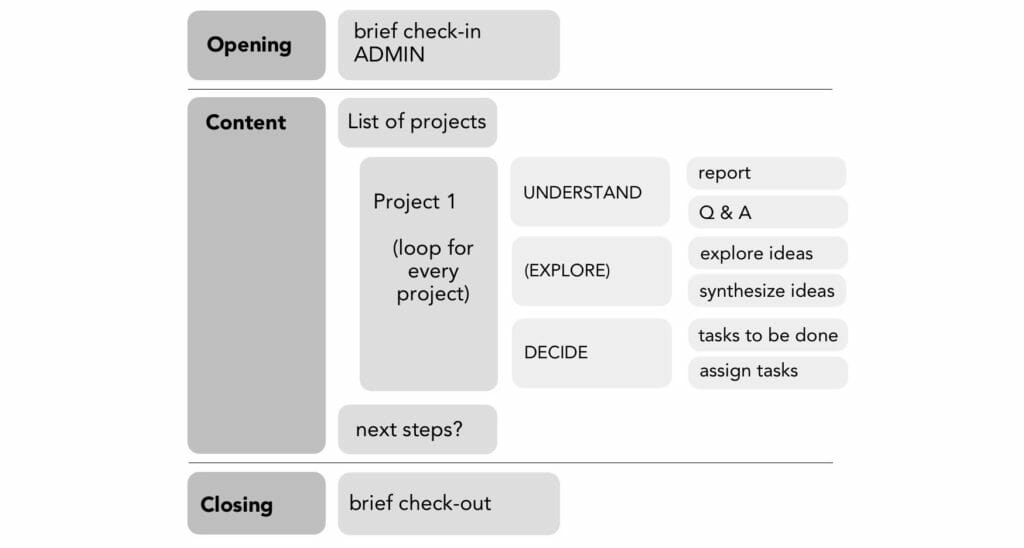
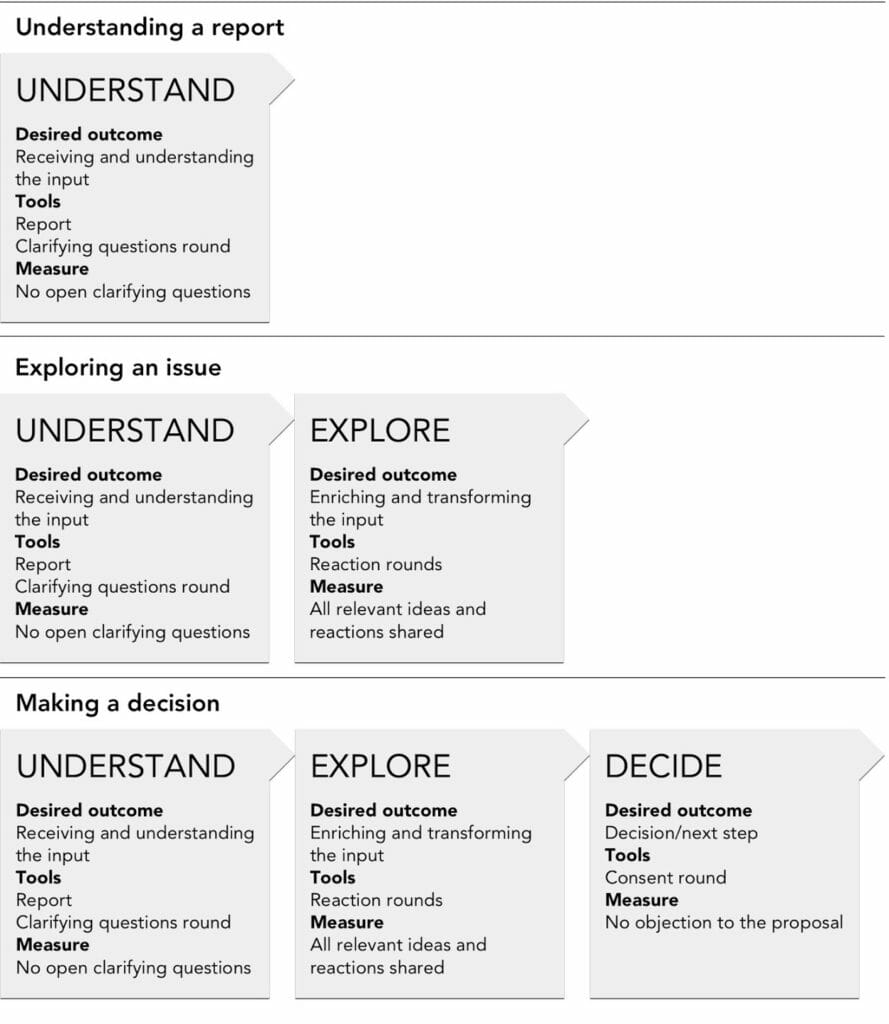
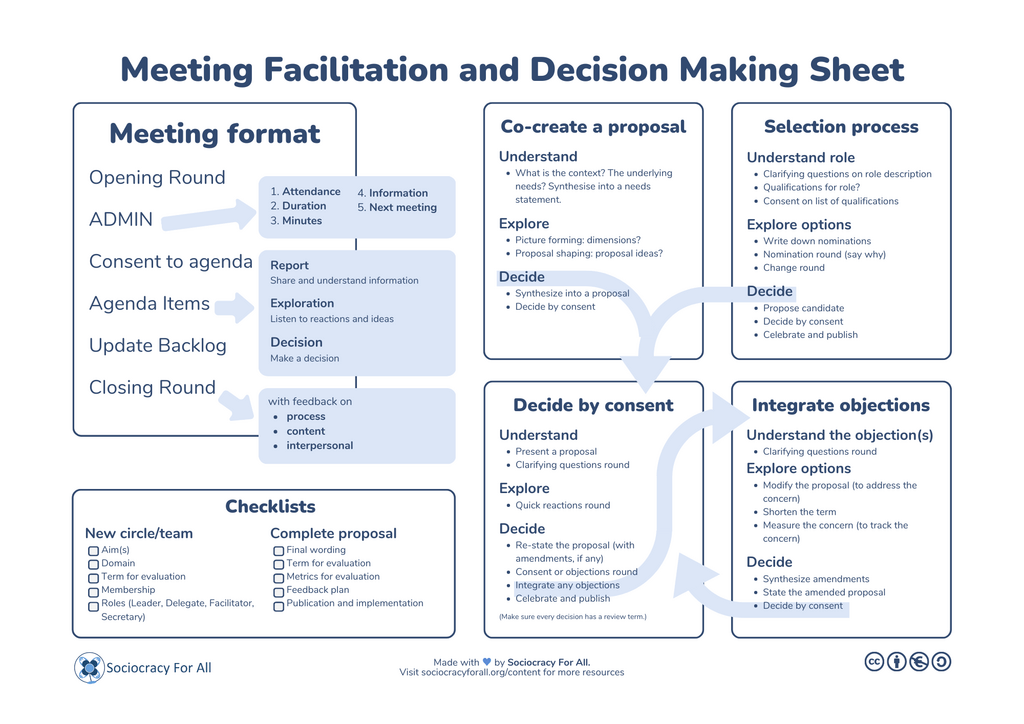
The Consent Process: Understand, Explore, Decide
The consent process follows three steps:
- Understand: The group asks questions to make sure everyone understands the proposal.
- Explore: The group shares reactions to the proposal, speaking one by one without interruption.
- Decide: The group checks for consent. If no one objects, the proposal moves forward. If there is an objection, the group works to understand and resolve it, then checks for consent again.
This process ensures that all concerns are heard and addressed, while also keeping decision-making efficient.
Consent in sociocracy is a balanced decision-making method that allows for inclusivity without the long delays of consensus or the exclusion of important voices, as seen in autocratic and majority vote methods. By focusing on whether a proposal aligns with the group’s aim and addressing objections constructively, consent ensures that decisions are made efficiently and that they support the organization’s overall goals.When objections arise, the group can address them in several ways:
- Modify the Proposal: Change the proposal to fix the issue raised by the objection.
- Measure the Concern: Track the potential negative impact to see if the concern is valid over time.
- Shorten the Term: Implement the proposal for a limited time, then review it to see if the objection still holds.
These options allow the group to continue moving forward while addressing concerns in a practical way.
Demo of a consent process without objections
Additional resources (optional)
We recommend you read our article on how to integrate objections.
After enjoying this socicoracy introduction, watch more recordings on our facilitation page – including a consent process with objections
Facilitation sheet
This is a great thing to print and keep!
You can download it in full size and print it!

Unit 3
Who decides what?
We’ve talked about how to make the fundamental decisions – by consent.
But who decides what? And who decides who decides what?
Read the transcript instead:
If everyone decides everything together
Let’s explore different organizational structures and their decision-making methods. We’ll look at various models, weigh their pros and cons, and then see how sociocratic structures offer a more flexible and effective alternative.
One Big Group Decision-Making
In this structure, everyone in the organization decides everything together as one large group. The benefit is that it can be very transparent and inclusive. Everyone gets to hear everything and has a chance to express their opinion, which can feel very democratic. However, the downside is that it becomes very time-consuming, especially in large groups. It can also be less inclusive in practice because only the most confident or outspoken individuals may have time to speak, while those who are more introverted may struggle to be heard. This leads to an inefficient and unequal decision-making process in large organizations.
Decentralized Small Group Structures
An alternative is to have smaller groups where each team focuses on different areas. This can solve some of the issues from the large group model—teams can hear each other better, focus on specific topics, and make decisions more efficiently. However, problems arise with communication and cohesion. How do the teams know what each other is doing? Without coordination, teams may compete with each other, do duplicate work, or fail to align with the broader goals of the organization.
Hierarchical Structures
Another familiar way of organizing is the hierarchical model, where there is someone at the top who gives instructions, and middle management passes these instructions down to the people doing the work. The advantage of this system is that it’s fast—when the boss says something, it gets done without much discussion. It can also create alignment because there’s one clear voice giving orders. However, this system has obvious downsides. People may not like being told what to do, and valuable information from the workers can get lost or distorted as it moves up and down the chain of command. Even though hierarchical structures aim for alignment, the flow of information is often imperfect, leading to mismatches between what the organization needs and what actually happens.
Sociocratic Structures
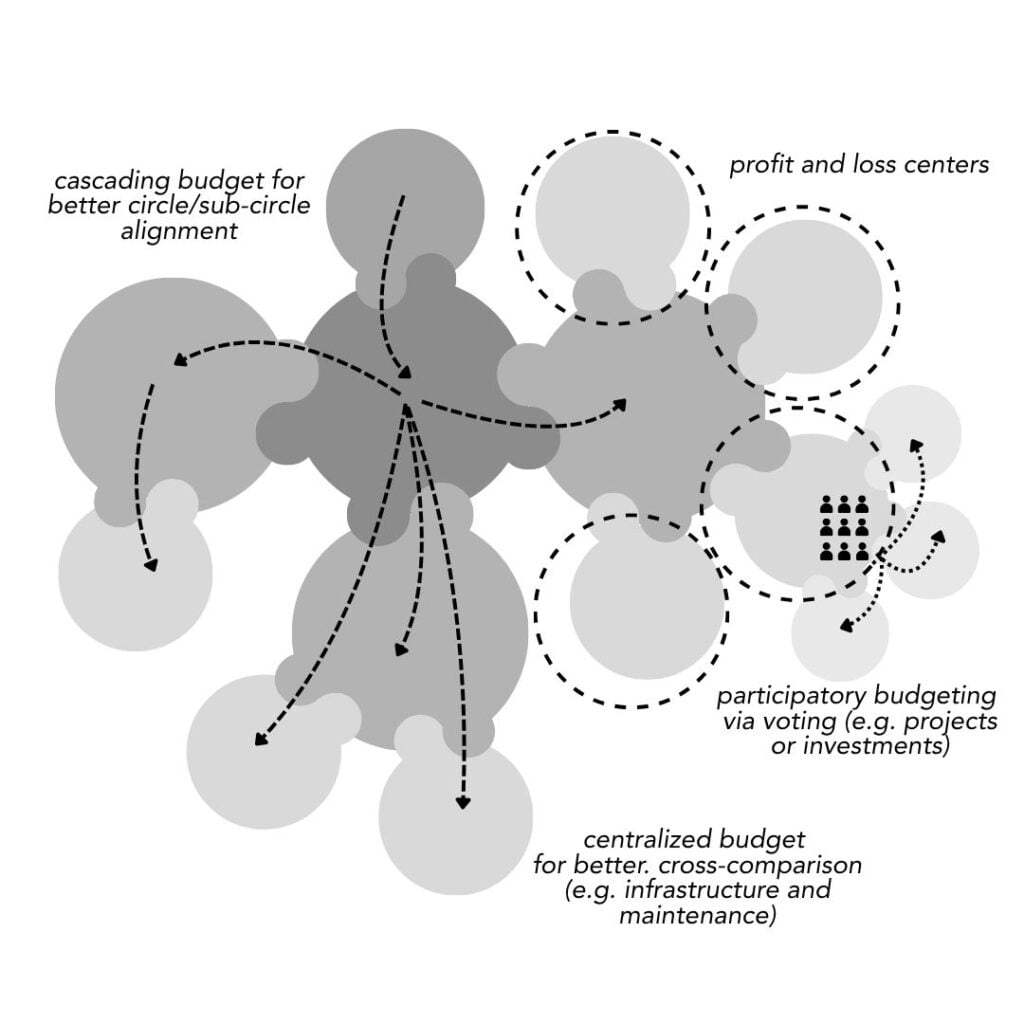
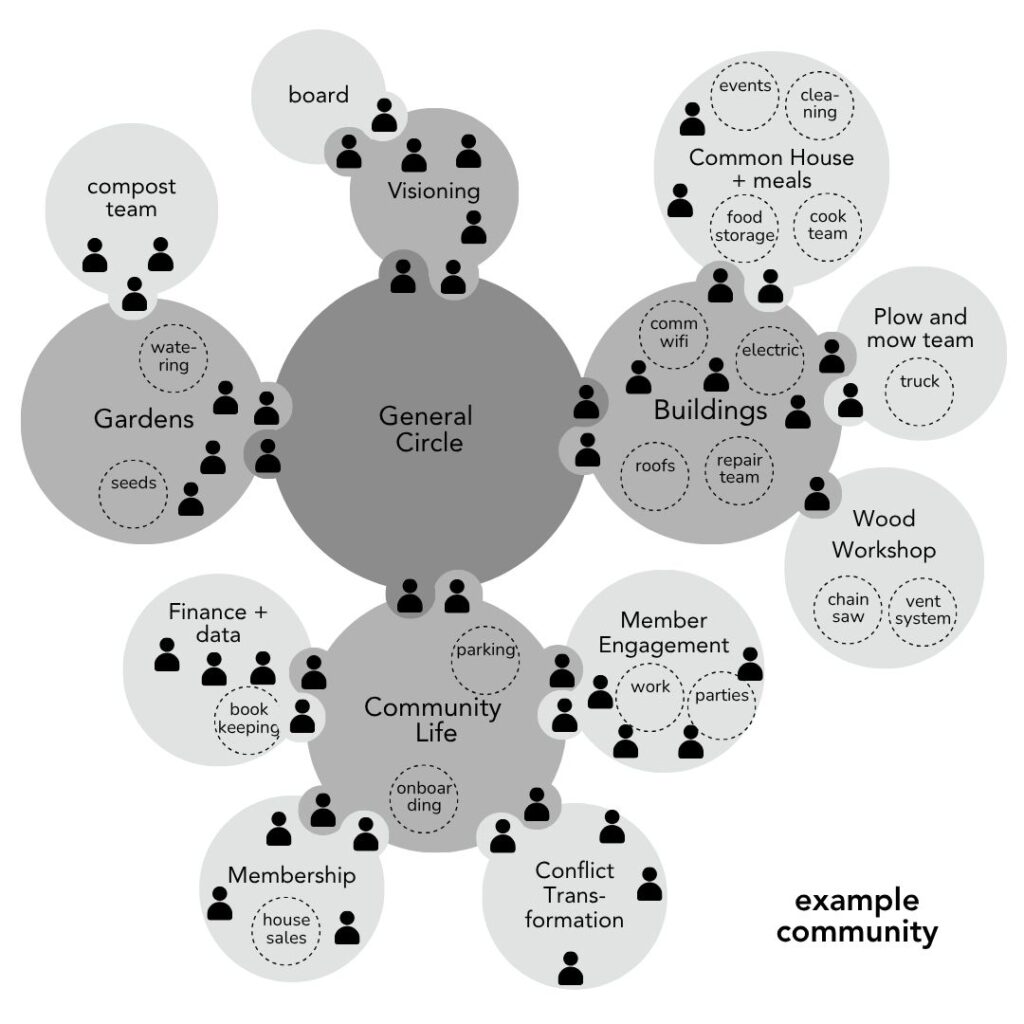
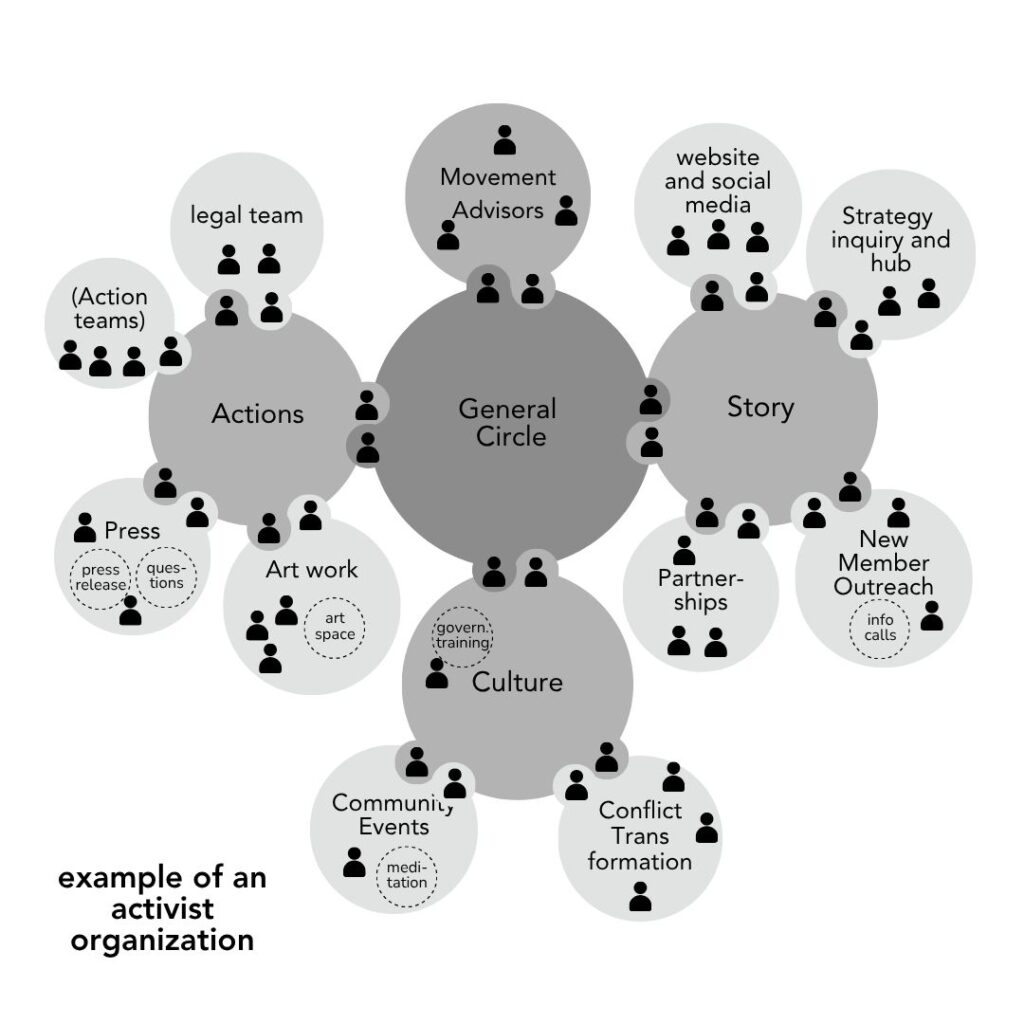
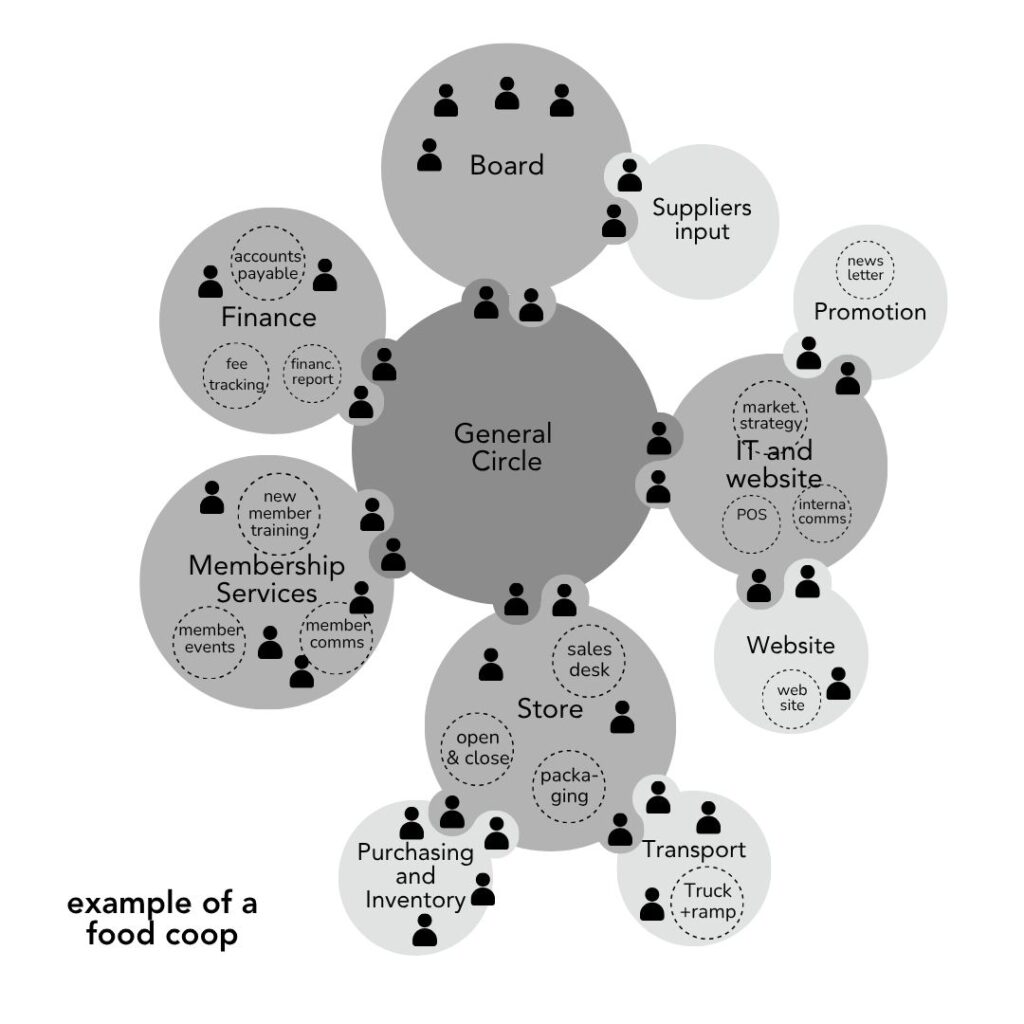
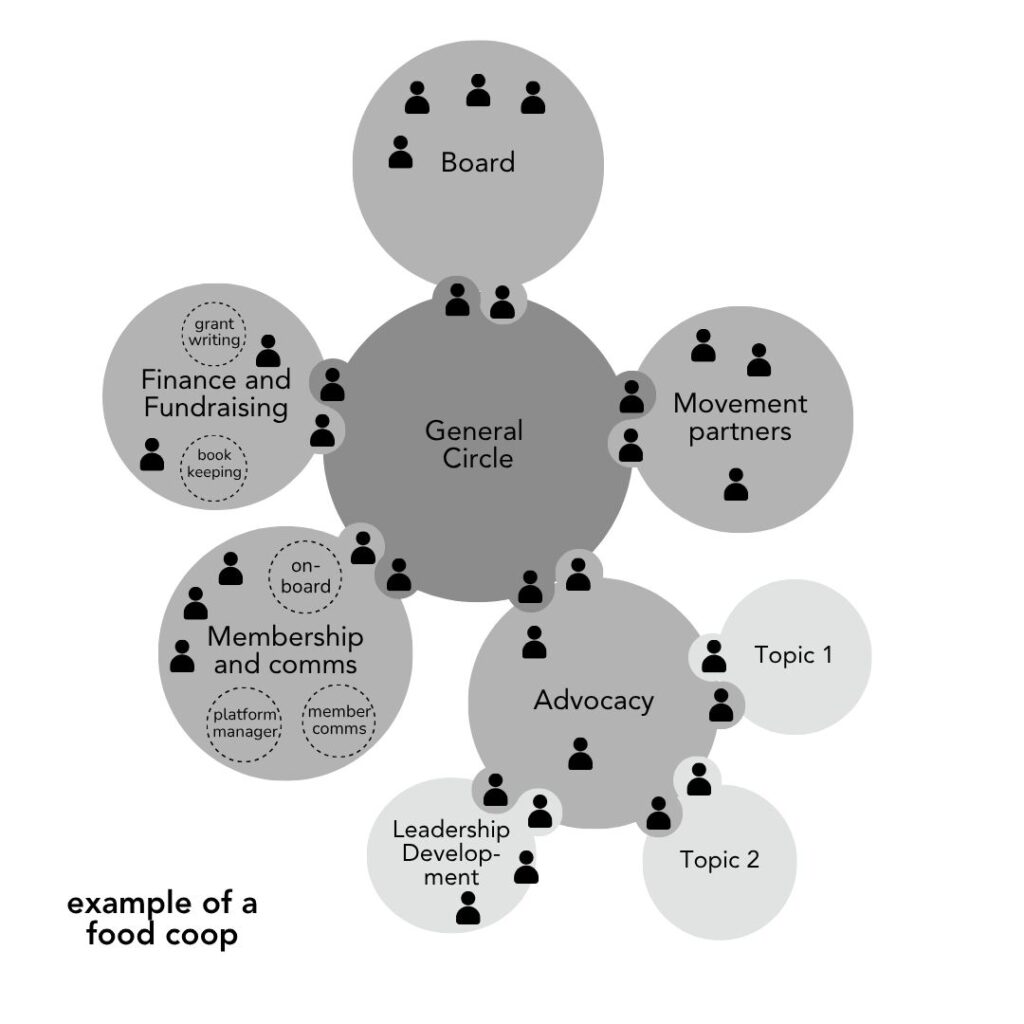
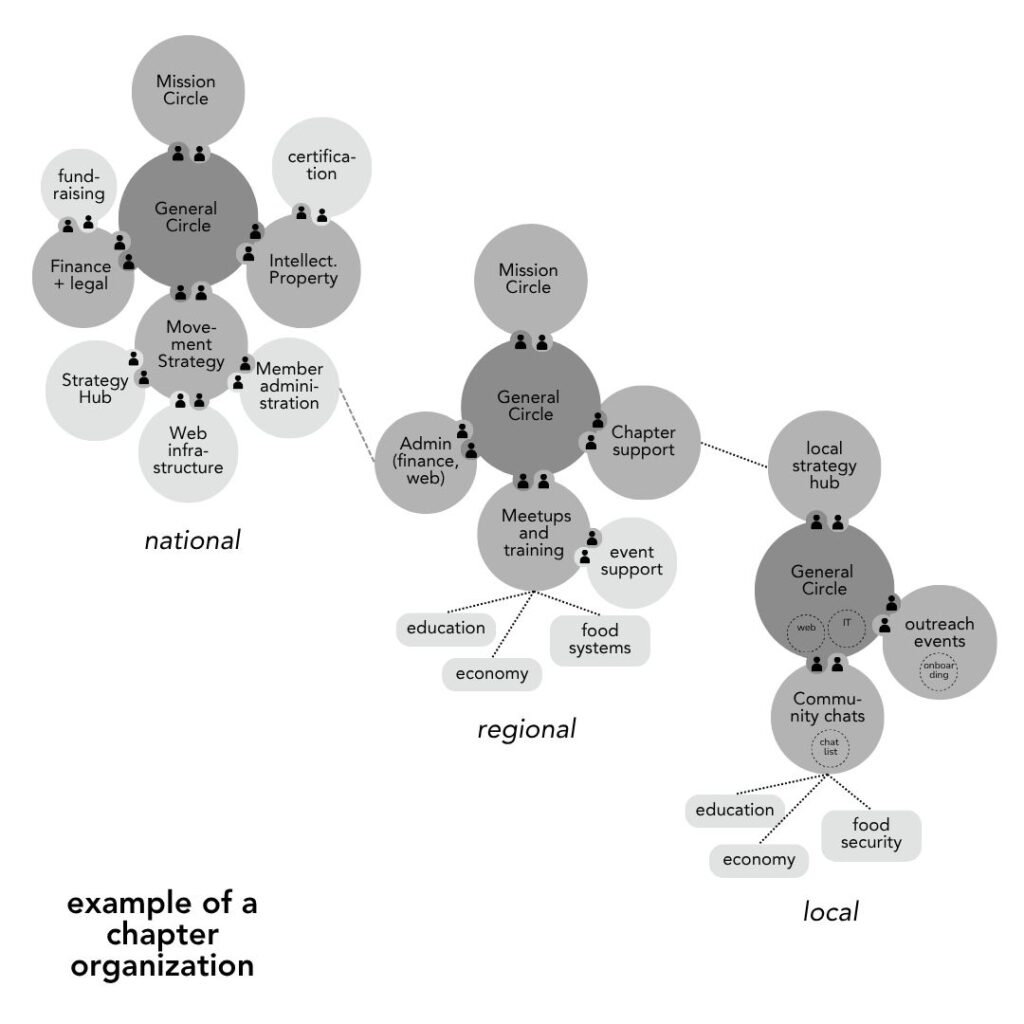
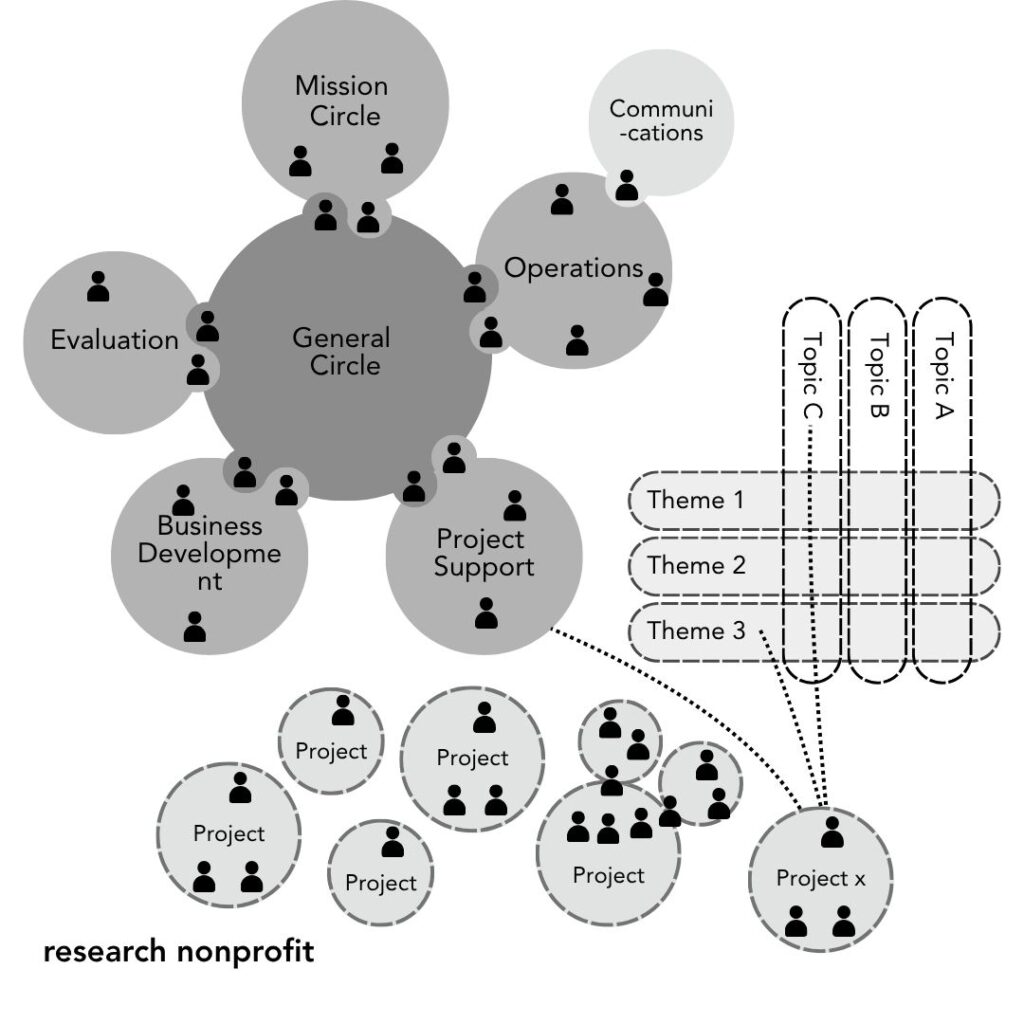
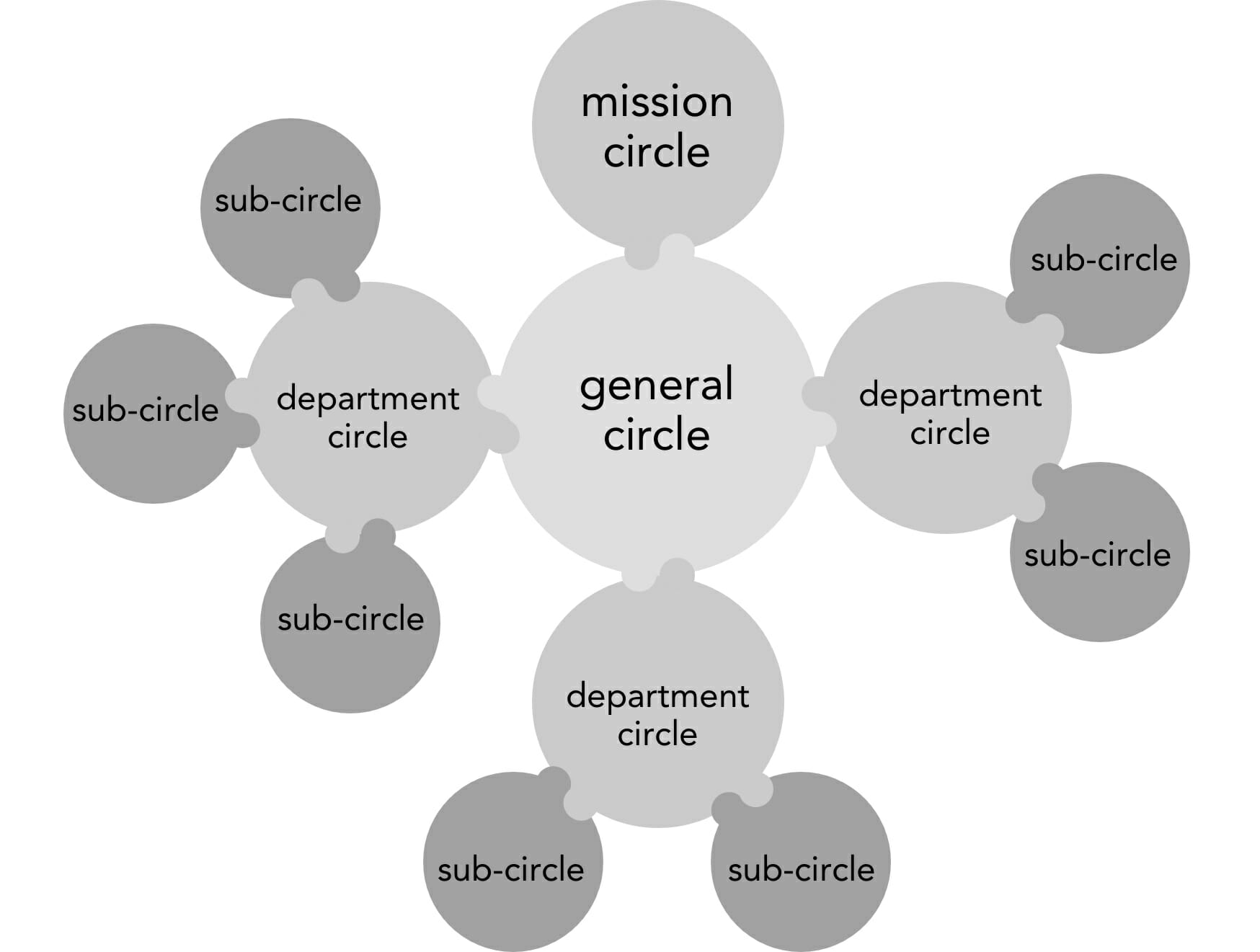
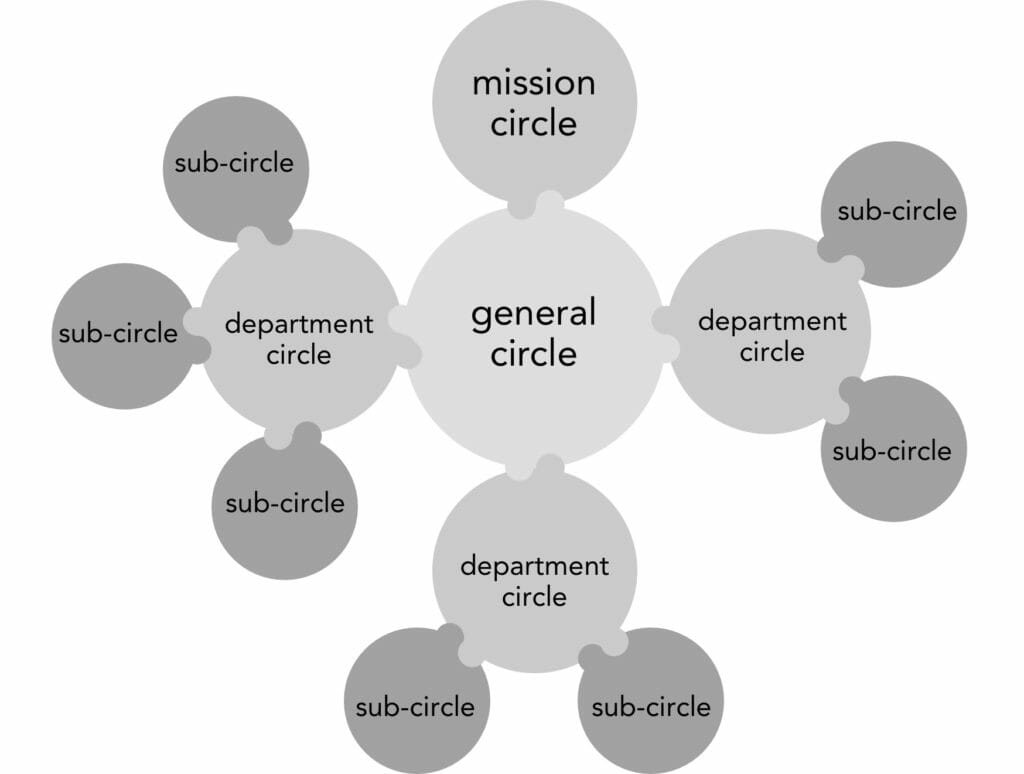
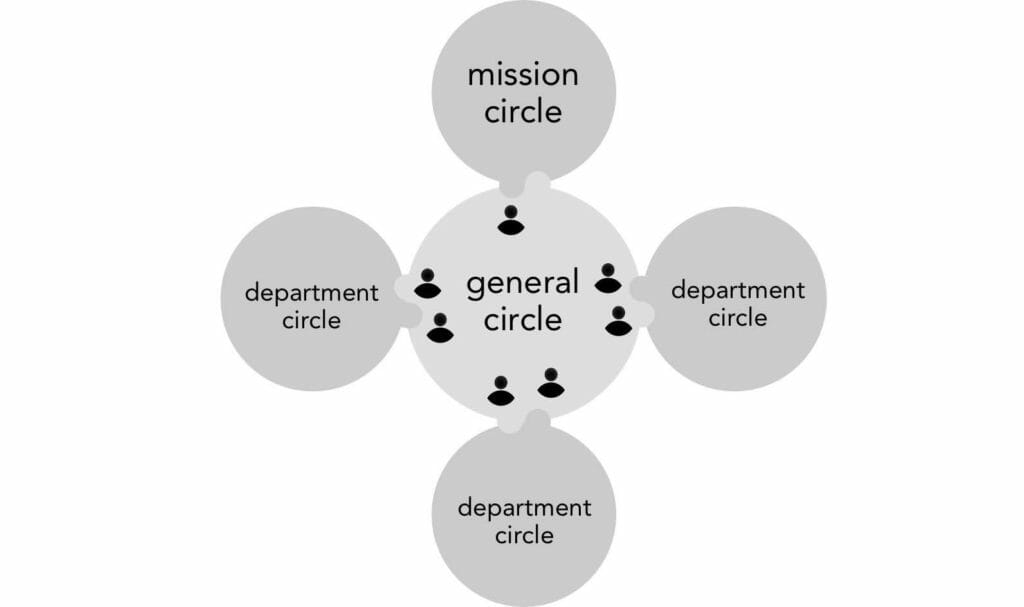
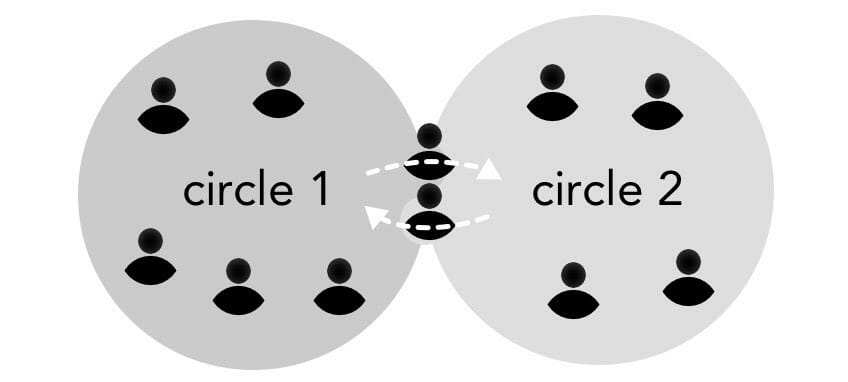
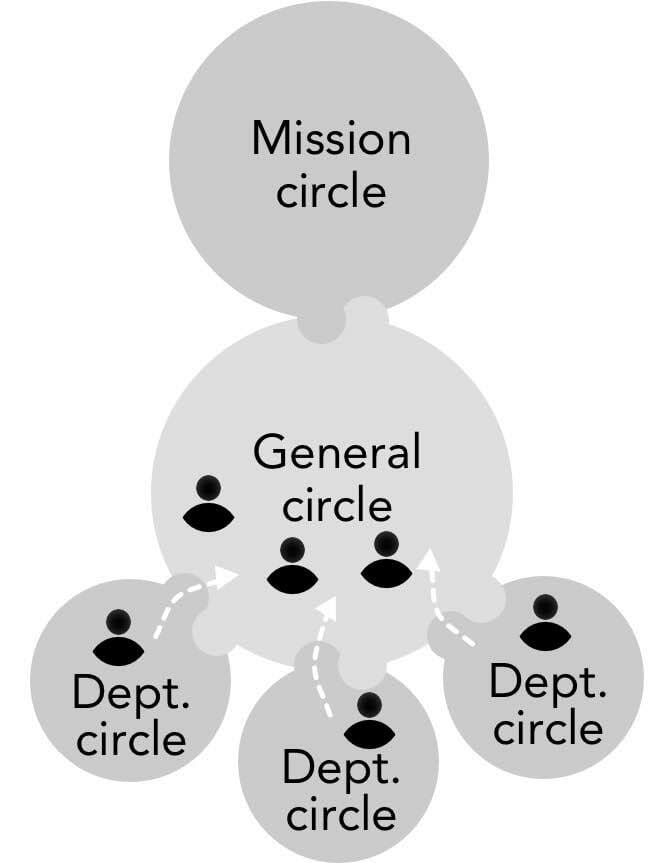
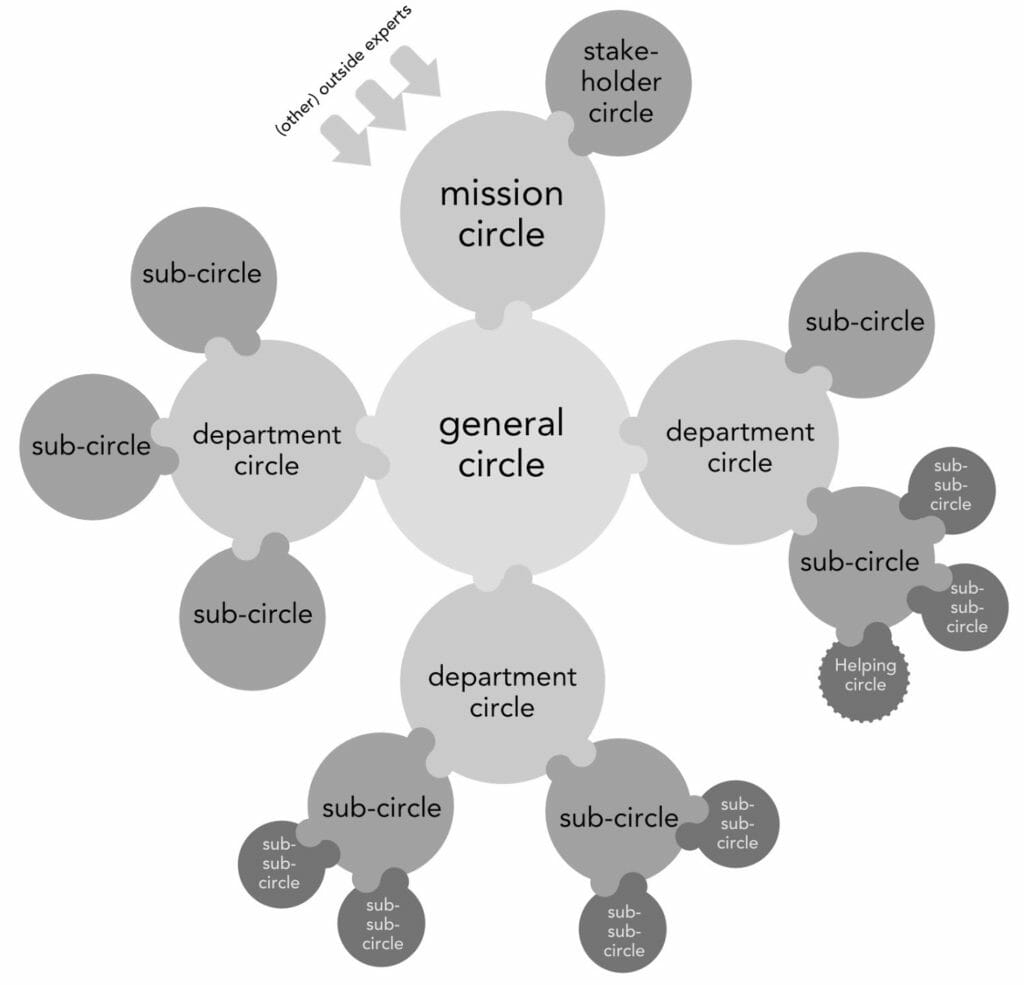
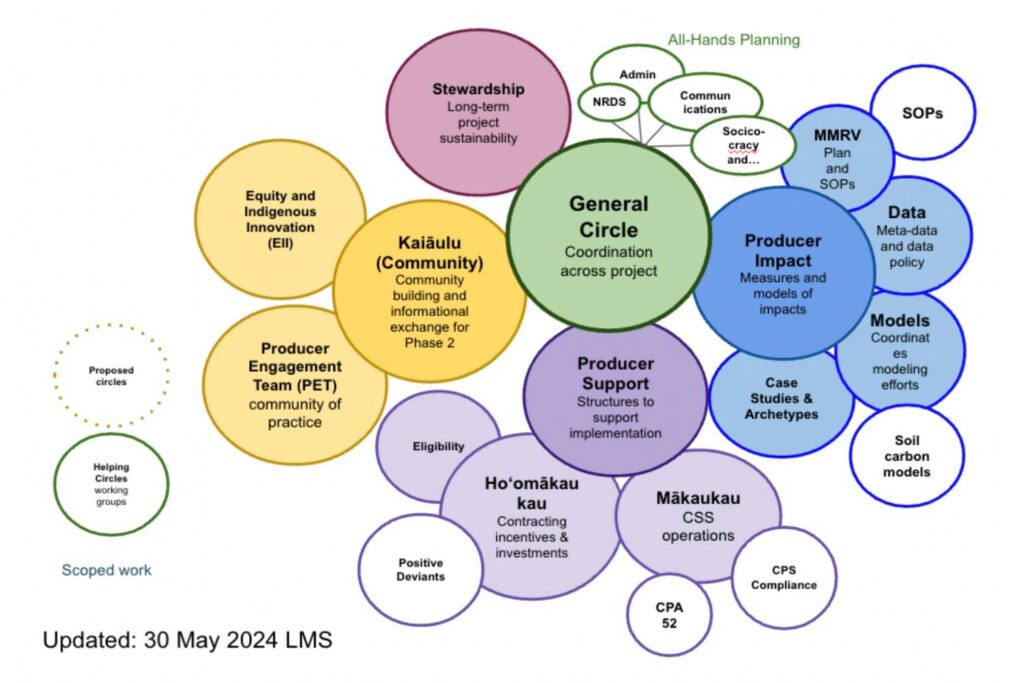
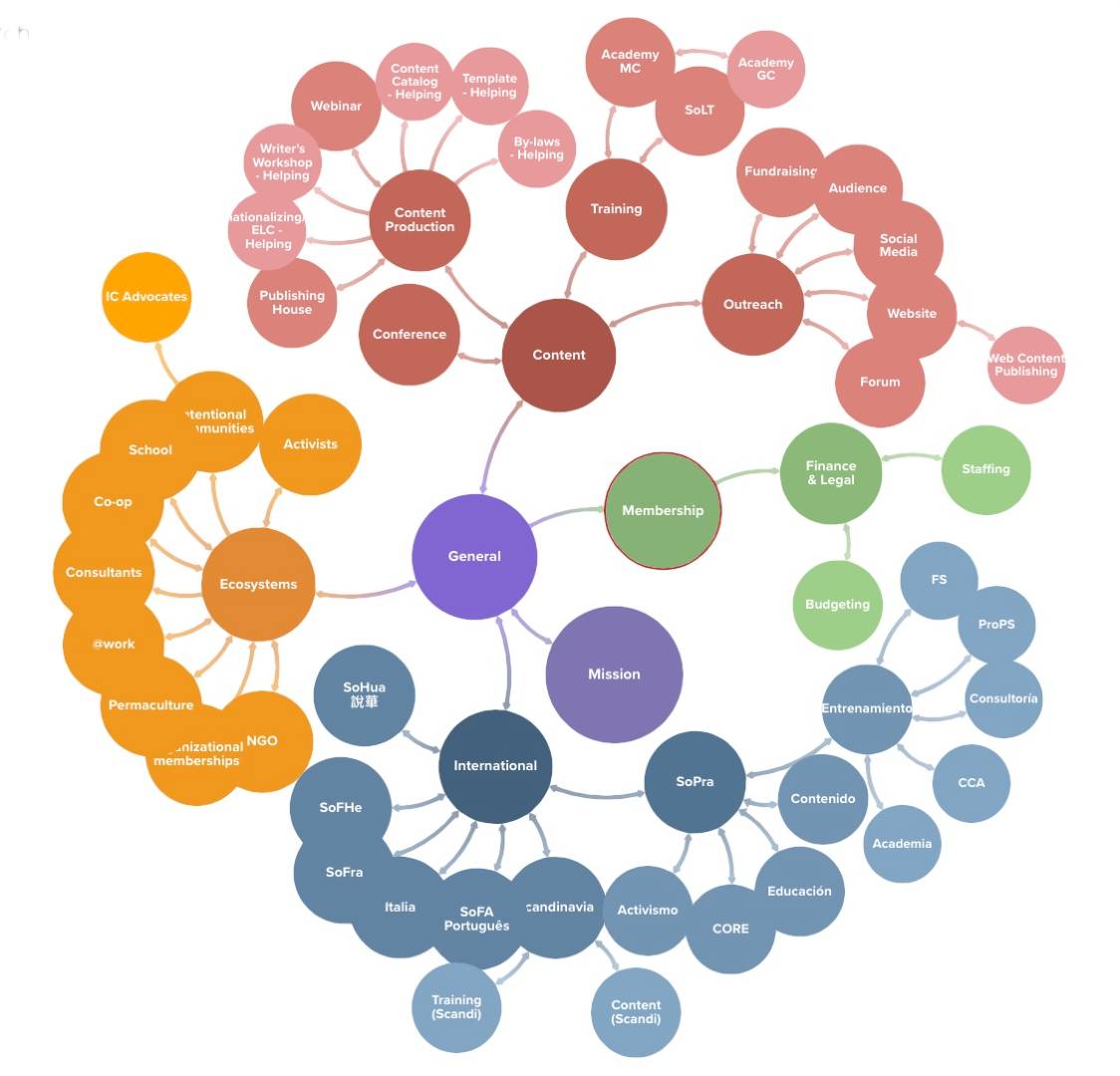
Now let’s look at sociocratic structures. In sociocracy, we have teams or circles that make decisions independently within their domain. To ensure alignment across the organization, each circle sends two representatives to a larger circle, known as the General Circle. The General Circle is responsible for making decisions about how the different pieces of the organization fit together and ensuring alignment between the circles. One of the key responsibilities of the General Circle is deciding who makes which decisions. For example, the General Circle and Circle A will have an agreement about Circle A’s aim and domain, clearly defining what decisions Circle A can make.
Double Linking
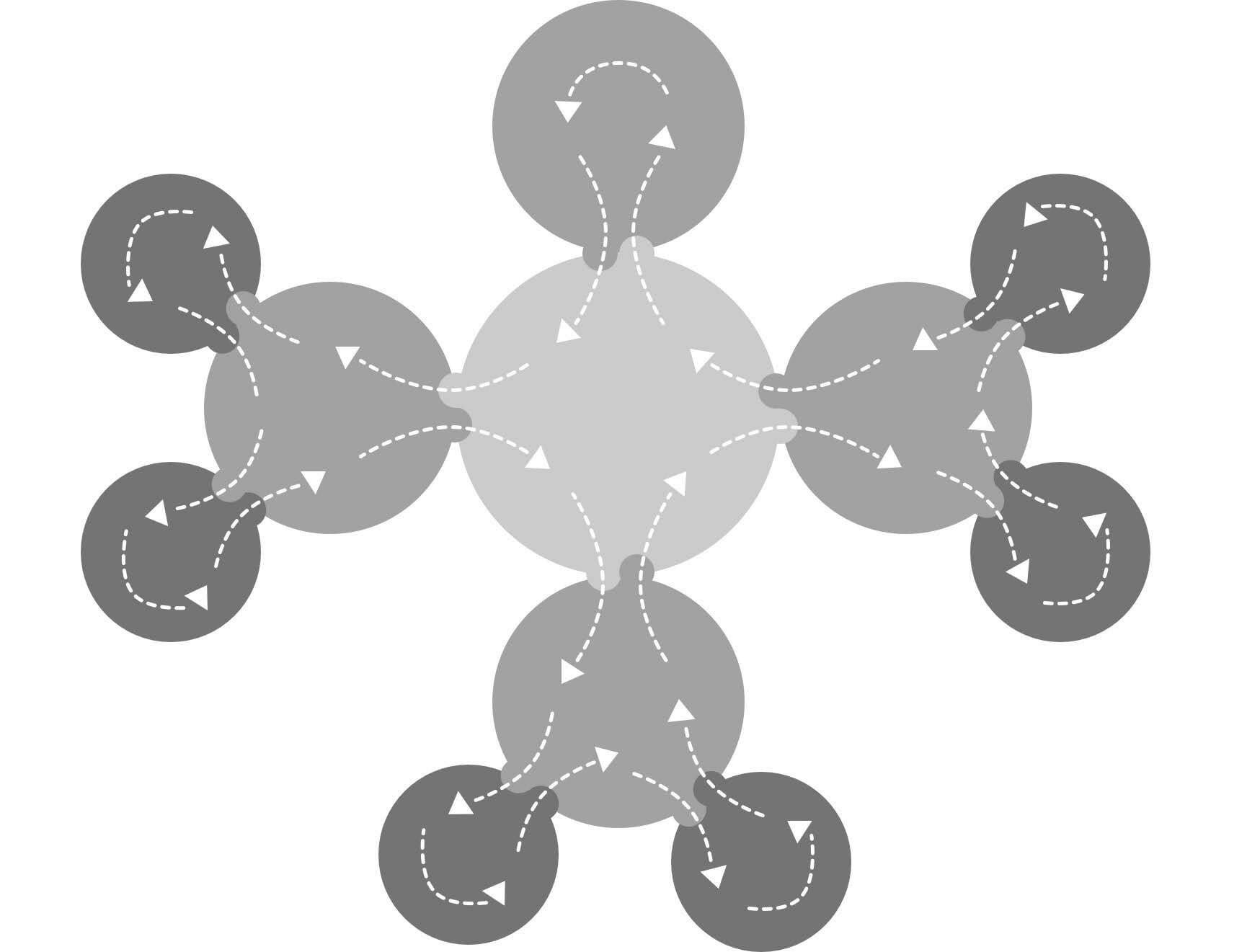
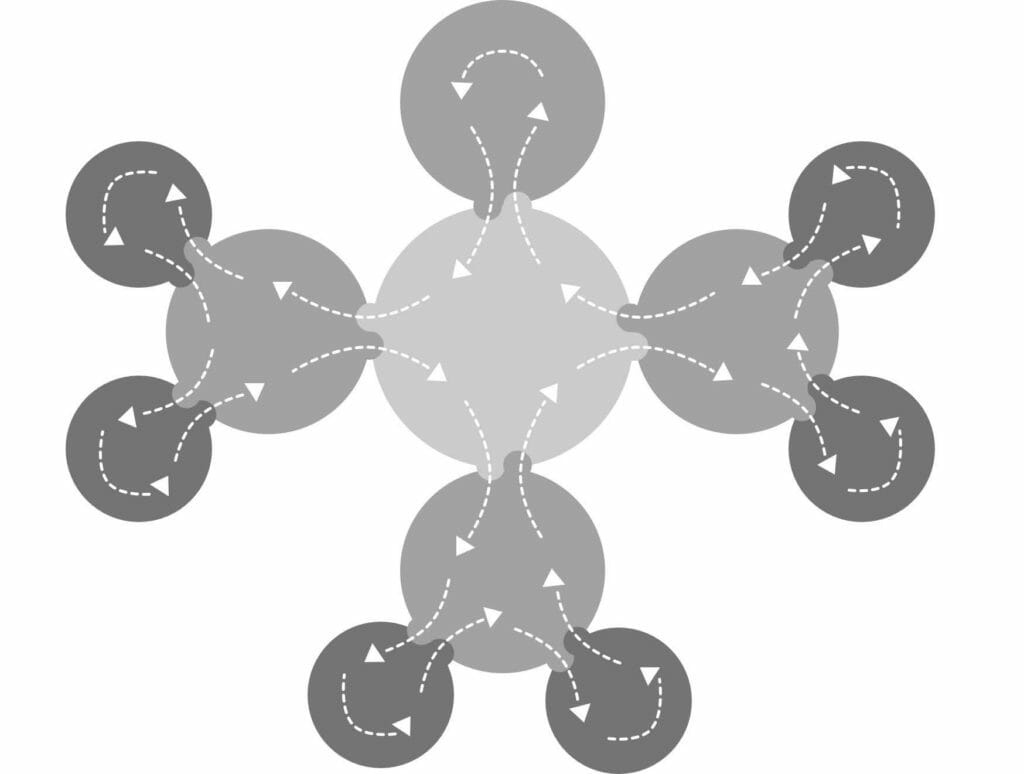
One of the important principles in sociocracy is double linking. Each circle sends two people—a leader and a delegate—to the General Circle. The leader brings information down from the higher circle, while the delegate brings information up from the lower circle. This ensures that information flows in both directions, creating a pattern where every piece of information can travel through the organization. This structure can be expanded indefinitely by adding sub-circles, all connected through double linking, ensuring that information continues to flow freely throughout the organization.
Roles in Sociocracy
In addition to circles, sociocracy also involves defined roles. Operational roles are specific tasks that are assigned to individuals, such as processing applications or managing membership. The circle creates policies that guide the work of these roles, so the person holding the role can make day-to-day decisions without needing to go back to the circle for every little detail.
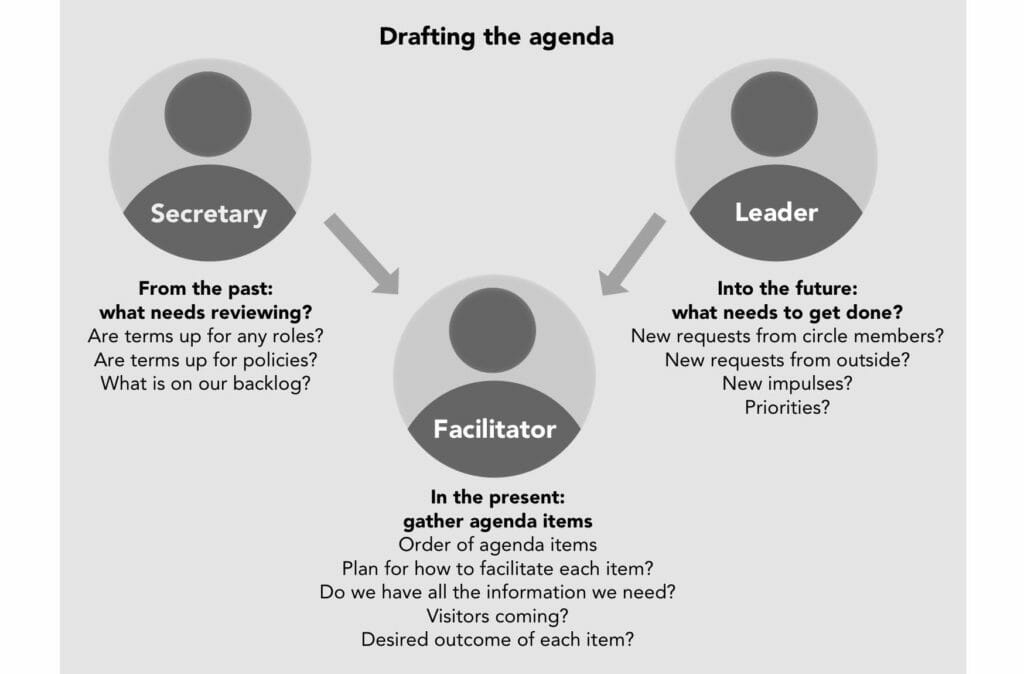
Each circle also has specific roles that keep the circle running, such as the leader (who ensures the circle makes progress), the delegate (who brings information to the higher circle), the secretary (who takes notes), and the facilitator (who runs the meetings). These roles ensure that circles function smoothly while staying aligned with the broader organization.
Conclusion
Sociocracy provides a structure that balances autonomy and alignment. By organizing decision-making in circles, using double linking for communication, and assigning operational roles, sociocratic structures solve many of the issues found in one big group decision-making, decentralized teams, and hierarchies. The system ensures that decision-making is distributed, while maintaining coherence and alignment across the organization.
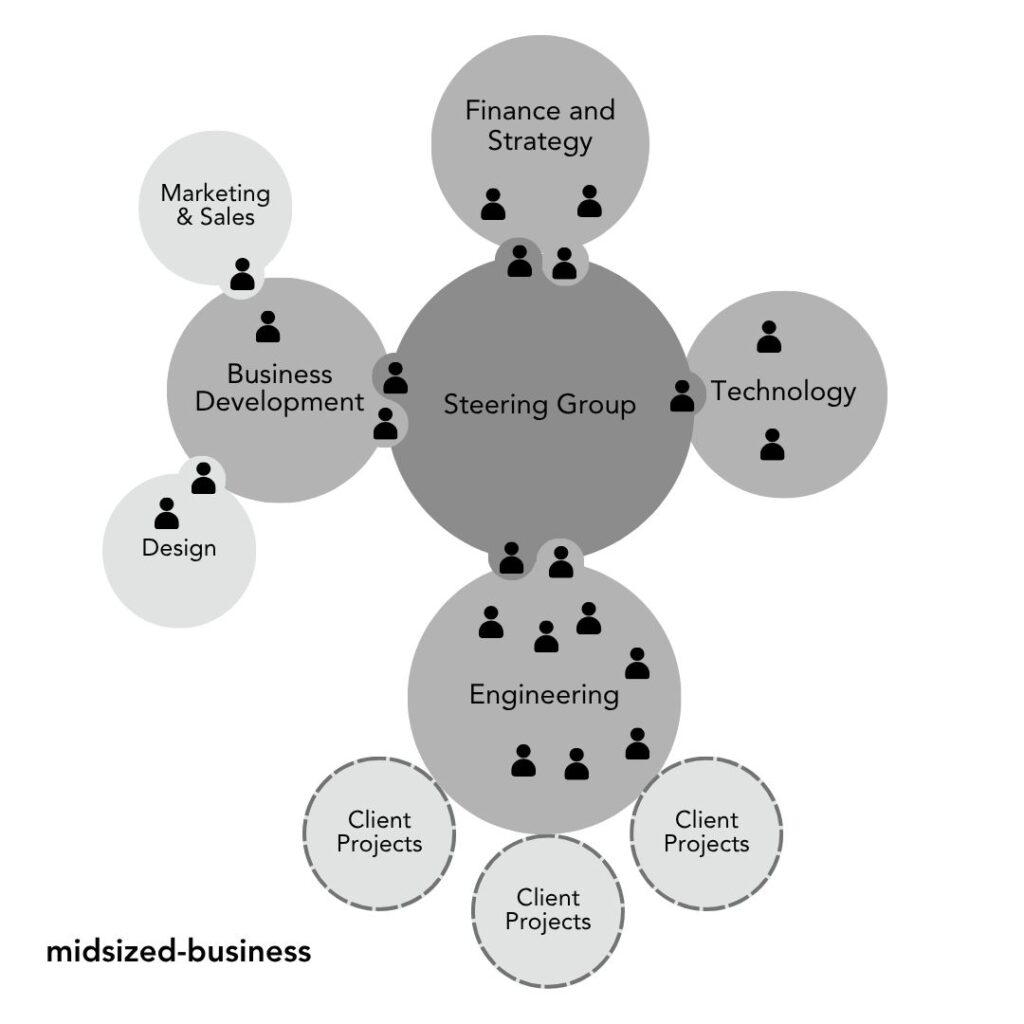
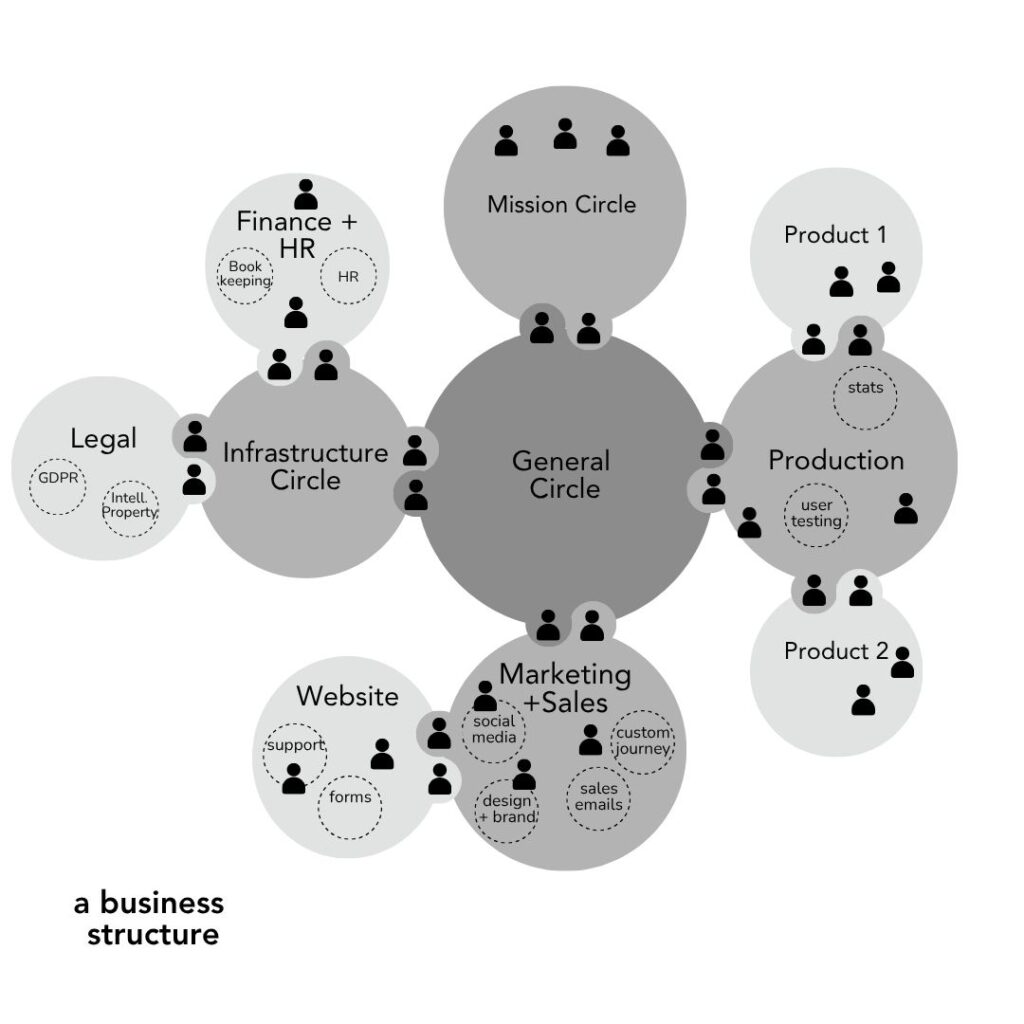
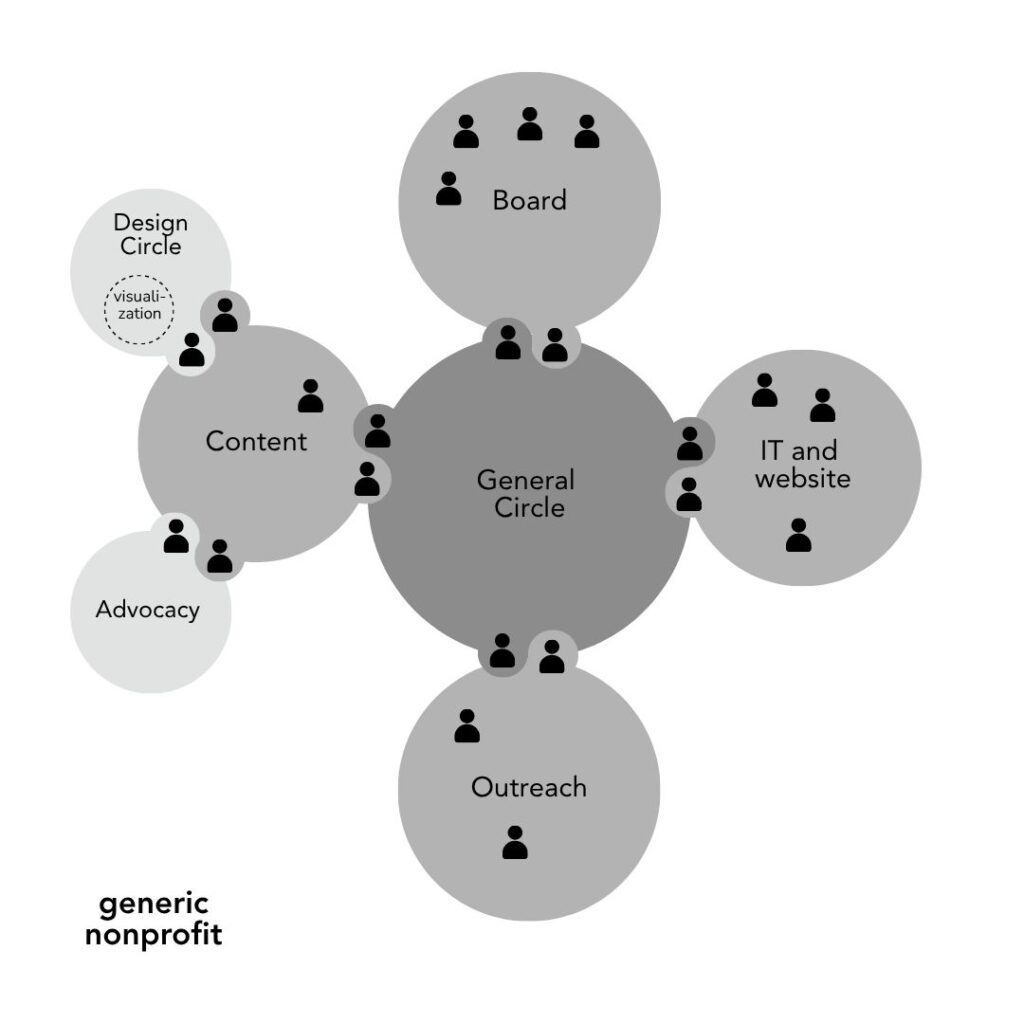
Examples of organizational structures
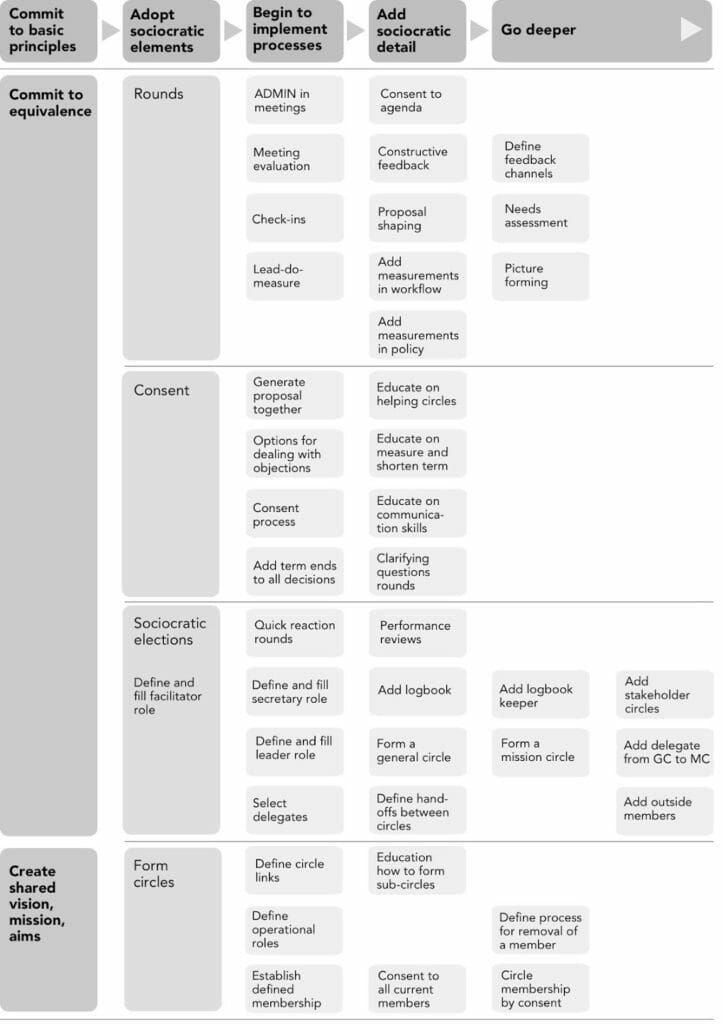
Find more example structures from the book From Here To There.

Unit 4
Effective meetings!
Why do we have meetings? And how can we facilitate them well?
Read the transcript instead:
Introduction to sociocratic meetings
Let’s take a deeper look at meetings, as there’s much more to say beyond decision-making and consent. Meetings in sociocracy involve several processes, and one key feature is the use of rounds. I’ve mentioned rounds earlier, but it’s worth highlighting again because of its importance. A round is when people speak one by one. Without a structure for who speaks and when, those who feel more confident will often dominate, while others might not get to speak at all. This dynamic is common, and using rounds helps to counter it.
The Purpose of Rounds
There are different ways to use rounds in a meeting. First, we have clarifying questions rounds. In this round, everyone has the chance to ask questions to better understand what has been presented, whether it’s a proposal or something else. These questions can either be answered immediately or all at the end of the round.
Next, we have reaction rounds. This is when we invite everyone to share their reactions to what’s been presented—again, whether it’s a proposal or something else. Finally, we use consent rounds where each person in turn gets to say whether they consent or object to the proposal. These rounds provide structure and ensure everyone’s voice is heard.
Reports, explorations and decisions in meetings
Meetings are also about clarifying the work and making sure everyone is free to act.
One way this happens is through reports. A report is when someone shares information that they want others to understand. For example, I might give a report about what’s happening in my area of responsibility, and then allow others to ask questions.
There’s also a practice of exploration, which often follows a report. In exploration, after I share my report, I ask for your ideas or reactions on how I could solve a problem or improve something. It’s rare to do an exploration without first having a report, as the report sets the context for the exploration.
A decision in a meeting follows a clear process. First, someone presents a proposal. Then, we do a round of questions to clarify the proposal, followed by a round of reactions. Finally, we move into a consent round where people can either consent or object. If there is an objection, we go back to understanding the objection, exploring possible amendments, and deciding again, using the same process of understanding, exploring, and deciding.
Making policies to increase effectiveness and save time
The goal of sociocratic meetings is to create clarity and alignment so that everyone can act freely. By clustering responsibilities into roles—like assigning someone to handle a recurring task—we reduce the need to constantly coordinate. For example, if someone is particularly good at cooking lunch, we can decide as a group that they will handle lunch for the next two months. This saves time and allows the group to focus on more important matters.
Similarly, making policy decisions can reduce friction in the organization. For instance, if there’s an ongoing debate about whether certain items should go into the compost, instead of discussing it case by case, the group can make a policy decision that applies in all situations. This reduces unnecessary discussions and allows the group to focus on doing meaningful work.
Another way to improve efficiency is by defining workflows. If a process happens repeatedly—such as onboarding new members—it’s helpful to have a defined procedure so that everyone knows exactly what to do. This eliminates the need to figure things out from scratch each time and ensures consistency. Defining roles, policies, and workflows by consent creates alignment and helps the organization function smoothly.
Policies and rules in sociocracy are not about limiting freedom or imposing control. Instead, they are decisions the group makes to make life easier. Rules are a good thing when chosen wisely, as they reduce the need for constant discussion and increase clarity and efficiency. Each organization must decide how many policies to create, balancing between too much rigidity and too much freedom.
Meeting recordings
A check-in round
Consent to agenda
Closing round
You can see the recordings of a whole meeting on our facilitation page.

Unit 5
Feedback
The mechanisms that keep the whole thing going.
Read the transcript instead:
Feedback in sociocracy
This video is about feedback, and before I begin, I want to share a concept: feedback adds a fourth dimension to organizational dynamics. To explain this, let’s think of the first dimension as a single person. The second dimension is a group of people—a circle—making decisions by consent to achieve a common goal. The third dimension is when multiple groups form an organization, and the fourth dimension is time. Feedback introduces the time dimension because it allows us to improve and adapt over time, evolving along with our environment. Feedback is essential because it enables us to adjust our course based on real-world experience, rather than continuing in the same direction without reflection.
Feedback is crucial to the consent process. In sociocracy, we aim for decisions that are “good enough for now” so that we can try them out and learn from reality rather than relying on hypotheses. The idea behind “good enough for now” is to start with a workable decision, then gather feedback to refine it. Consent and feedback are closely connected because feedback allows us to test whether a decision works in practice and improve it based on what we learn.
Feedback also plays a key role in the decision-making structure. Circles are empowered to make decisions in their domain, but they ask for feedback from others as they see fit. This consultation allows circles to make better decisions, even though they act independently. Through feedback, decisions and actions can be continuously reviewed and improved.
Feedback loops and term limits
Feedback operates on multiple levels and timeframes. For example, after a meeting, you can evaluate how well it went. This is a short feedback loop—perhaps an hour or two. But there are longer feedback loops as well. You might make a decision and review it three months later to see if it worked, or you might select a facilitator and evaluate their performance after a year. Circles and roles are also reviewed periodically to assess whether they are fulfilling their purpose.
Nothing in sociocracy is set in stone. Every decision, even your governance system or mission, can be reviewed and adapted over time. A system that doesn’t allow for feedback becomes stagnant, but a living system constantly renews, adapts, and grows. Organizations that align with this principle of ongoing feedback are healthier and more resilient.
Feedback and performance reviews
Many people shy away from feedback because they’ve experienced feedback as a form of criticism or power-over dynamic. But in sociocracy, feedback is about contributing information to help the system understand itself better. By sharing what we see, we help the organization improve. Withholding feedback leaves the system with less information and makes it more vulnerable to mistakes. In sociocracy, feedback is not only an opportunity but also a responsibility.
This redefines how we think about feedback. Just like objections, feedback is a way for everyone to co-create and co-improve the system. It’s part of the practice of being co-responsible for the organization’s growth and well-being.
Performance Reviews in Sociocracy
A performance review in sociocracy works through a 360-degree feedback process. This means that when someone has been in a role for a certain time, their peers provide feedback to help them develop. If that person grows, it benefits everyone, so we offer feedback to support their development. After gathering the feedback, an improvement plan is created by consent with everyone involved, including the person being reviewed.
This approach to feedback ensures that no one is pushed into something they don’t agree with. Instead, it becomes a collaborative process to explore how the system and each person’s contribution can improve, benefiting the organization as a whole.

Unit 6
Leadership and Accountability
How leaders can contribute to the bigger whole in a peer-based system.
Read the transcript instead:
Selections
The last topic in this sociocracy introduction that I want to talk about is leadership and accountability. But first, let’s recap what we’ve covered so far. We’ve talked about governance as a way to create connections between individuals, the group, and the work. Then we looked at consent as a method to share power, setting foundational decisions so people can act freely. We also explored circles and roles, like the leader, facilitator, secretary, and delegate, and how these circles fit together to ensure everything has its place. Meetings were covered as a tool for creating clarity, and we touched on feedback as a way to steer the organization. Now, all of this comes together in the process of selections, which is how we choose people for roles like leader or facilitator.
Selection Process in Sociocracy
Selections in sociocracy happen in a circle. For example, a circle selects its facilitator. The selection process follows the typical structure of understanding, exploring, and deciding. First, we get clear on the role and what qualifications are needed. This is done by consent. Then, we move on to the exploration phase, where everyone in the circle nominates someone for the role. In the first round, everyone shares their nomination along with their reasons. These reasons provide valuable feedback, not just for the nominee but for the whole group.
After the first round, we move to the second round, called the change round, where people have the opportunity to change their nomination based on what they’ve heard. After this, the circle proposes a candidate for the role, including a term length for how long they will serve. The final step is to ask for consent to this proposal.
Consent in the Selection Process
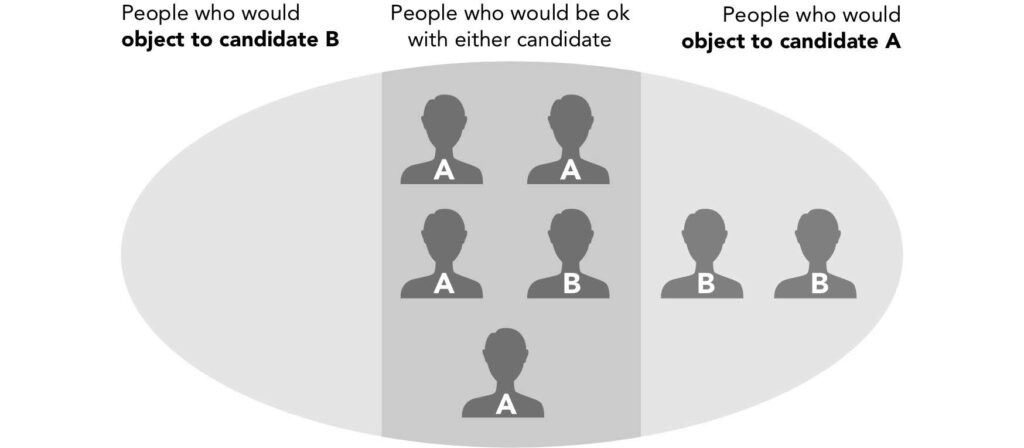
Consent in the selection process means that everyone agrees the proposed person can fulfill the role and help the circle achieve its aim. If someone objects, they must explain why the nominee cannot help the circle meet its goals. This objection needs to be based on specific reasons, such as the nominee lacking the necessary training. In such cases, the group might decide to provide training or shorten the term to test the nominee’s abilities.
The selection process emphasizes avoiding groupthink. By giving everyone the chance to independently nominate someone, we prevent the group from prematurely converging on one idea. The change round allows people to be influenced by each other’s reasons, which enriches the selection process and ensures that decisions are made collectively.
Shifting from Preference to Alignment
When making selections, the focus shifts from individual preferences to group alignment. The question is no longer about who is everyone’s first choice, but whether the group can work effectively with the proposed candidate in the role. This shift highlights the collaborative nature of sociocracy—everyone is working together to achieve the organization’s aims, rather than just pushing for their personal preference.
Hierarchy and leadership
Double Linking and Leadership Roles
In sociocratic organizations, leadership roles like leader and delegate are selected by consent. In a double-linked system, both the circle and the next higher circle must consent to a leader or delegate, ensuring accountability to both levels of the organization. This process shifts the power dynamics in a profound way. Leaders in sociocracy are chosen not because they are the most competitive, but because they demonstrate trustworthiness and the ability to work well with others.
Leadership as Noticing and Accountability
In sociocracy, leadership is not about bossing others around. Instead, leaders are responsible for noticing when something needs attention and bringing it to the circle for discussion. Leadership is about facilitating the group’s ability to work together effectively, not about controlling or directing others. Leaders help manage the organization’s processes, clarify work that needs to be done, and hold people accountable based on the group’s agreements.
Fluidity in Roles
One of the unique features of sociocratic organizations is that roles are fluid and modular. People can hold multiple roles across different circles, and leadership can shift over time. For example, someone might be the leader in one circle while being a regular member in another. This fluidity ensures that roles are shared and responsibilities can be adjusted as needed, without rigid hierarchies.
Leadership and Hierarchy in Sociocracy
Sociocracy maintains a hierarchical structure in terms of the work, not the people. Some circles focus on higher-level or abstract decisions, while others deal with more concrete tasks. However, this hierarchy is about organizing the work efficiently, not about creating power-over dynamics. Leaders in sociocracy are held accountable through the consent process, which ensures that their role serves the group’s goals.
Conclusion
Sociocracy creates a leadership model that fosters trust, collaboration, and accountability. By selecting leaders and other roles through a consent process, the organization encourages behaviors that benefit the whole group, not just individual ambitions. The fluidity of roles and the focus on feedback ensures that leadership is dynamic, adaptable, and aligned with the organization’s aims. This system empowers everyone to contribute to the success of the organization, making sociocracy a practical and holistic approach to governance. Thanks for reading this sociocracy introduction!
Watch a selection process
You did it!
You’ve completed the Sociocracy Primer – thanks from Sociocracy For All for your interest!
If you’d like to continue learning, scroll below.
Please consider donating to the nonprofit – it supports access, capacity and growth of the sociocracy movement.



What’s next?
Your options for learning more
Sign up for the free newsletter
- Weekly emails of easy and brief learning – learn sociocracy in 3 minutes a week!
- Perfect next step to refresh and deepen
- Makes it easy to stay in touch and learn about new resources.
Study and practice in your own group
- Requires a group of 4-7 people
- Buy our affordable video-led training for groups, $120/group.
- 4×2 hours of training + exercises
- The videos will walk your group through doing the exercises, rounds, and processes.
Our flagship program

Your chance to try out sociocracy firsthand
- 2 hours/week of sessions
- 23 weeks total
- learn, reflect, practice, and apply sociocracy in a motivating and safe learning environment.
- With option of facilitator certification