
Sometimes meetings seem to last forever; sometimes time just flies! As a participant, it’s easy to talk for 5 or 10 minutes straight — that can be 1/10 of the meeting used up already. As a facilitator, it’s excruciating to watch the time pass by, but for some, interrupting someone is even more excruciating. In a word, time management in meetings is hard.
In this recorded webinar, Ted Rau (Sociocracy For All) walks through every place where meeting time quietly leaks away — and what sociocratic practice does about it, in both in-person and remote meetings:
- Before the meeting: agenda planning. Learn how naming each agenda item as a report, exploration, or decision creates instant clarity for facilitator and participants alike — and how getting explicit consent to the agenda up front gives you something real to hold people accountable to later.
- During the meeting: staying on track. Practical moves for redirecting rambling contributions without shaming anyone, handling disruptive counter-proposals, renegotiating time agreements when discussions run long, and using a “backlog” to park good ideas without derailing the agenda.
- How your organization’s structure affects meeting time. Why group size, clearly defined membership, and delegating recurring issues to roles and circles (domains) keeps meetings focused on what actually needs a room full of people.
Watch the recording for concrete templates, facilitator language you can borrow word-for-word, and Ted’s take on why honesty — not just structure — is the real key to lasting time management in meetings.
If you are looking for a class, check our offerings for individuals and groups
Resources mentioned in the webinar
- Sociocracy in large groups?
- “What if people don’t cooperate?” A systemic view of meetings
- Strategies for integrating objections
- The tragedy of a meeting
- The 5min timer (counting upwards). Download and add as a background option in your zoom video settings. It will run upwards for 5min; if you want to reset it, re-select the video. (Not a perfect solution but quite ok.)
Not mentioned but very related. Learn how to hold a sociocratic meeting,
Form a Study Group
Summary: Time Management in Meetings
There are four areas that make the biggest difference for time management in meetings: people, clarity, accountability, and honesty. How many people are in the room, and who they are, has a big impact on meeting length. Clarity — knowing what we actually want and where we’re heading — may be the single biggest leverage point; without it, we meander and it takes forever. Accountability, in the sense of doing what we said we would do, keeps trust and connection from breaking down. And honesty means actually naming what isn’t working, instead of quietly living with a meeting culture we don’t like.
People: Group Size and Membership
Whose meeting is it, and who’s in the room? That’s often a tricky and overlooked starting point for improving time management in meetings.
In sociocracy, we tend to work in small groups — five, maybe eight, nine, or ten people, but not much bigger than that for decision-making. If someone tells me it takes a long time to make a decision with a group of 30 people, I’m not surprised — that’s exactly why I don’t do it. Large groups are great for exploring together, learning together, or connecting — but not for decision-making, which depends on hearing each other and deliberating. It’s hard for everyone to really hear everyone else in a group of 30.
Even in a small group, though, people can meander if they don’t know the purpose or scope of the group. Not knowing what you’re there to do costs a lot of time.
Membership matters too. If a different subset of people shows up each time, the group ends up having the same discussion again and again with slightly different people — a kind of Sisyphean task. Sociocracy addresses this with defined membership, so a group stays a functional group that knows what it’s doing.
If your group already has small size and defined membership and you’re still going over time, the next question is whether your agendas are chronically overfull. If so, it may be time to form a subset of people to take something on:
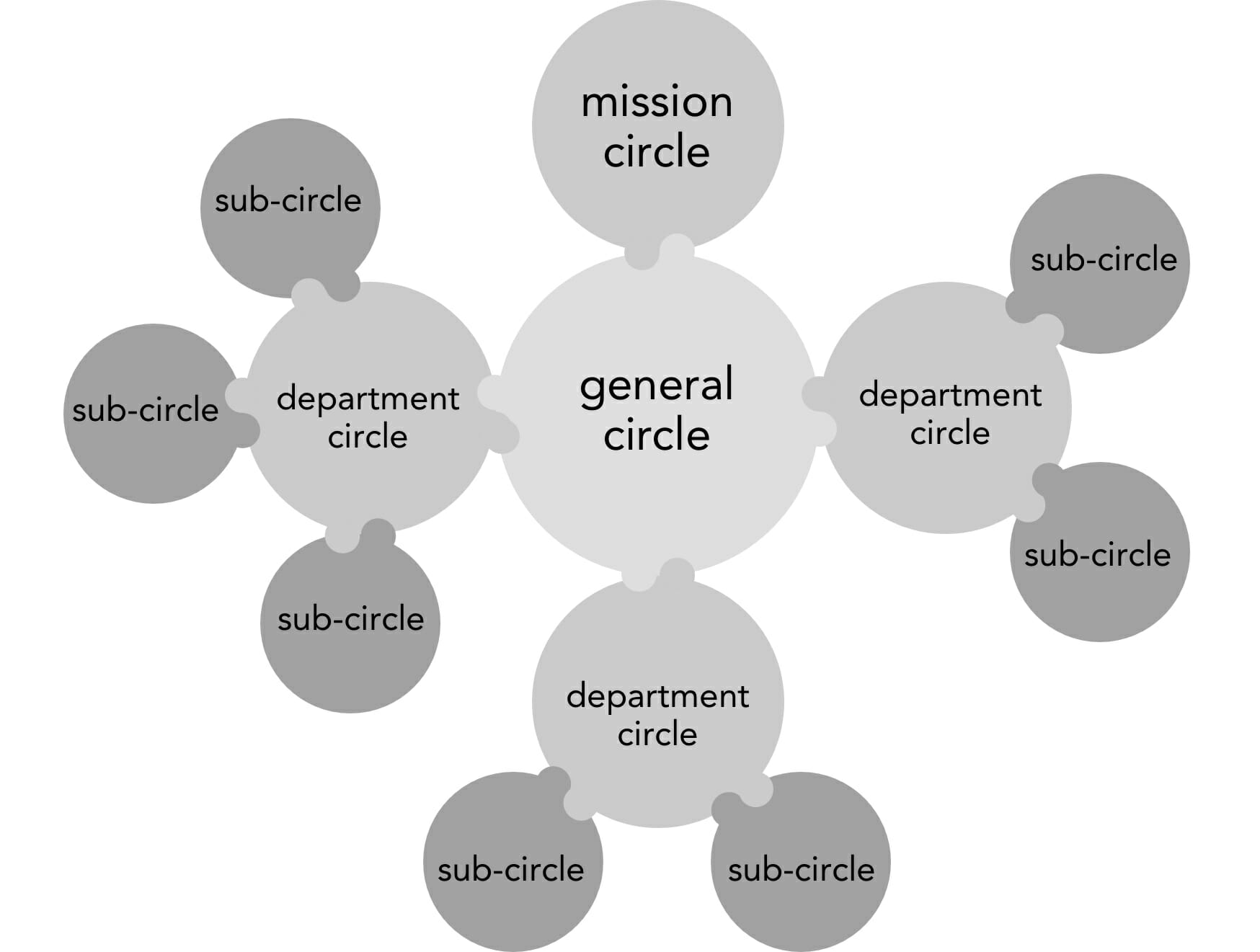
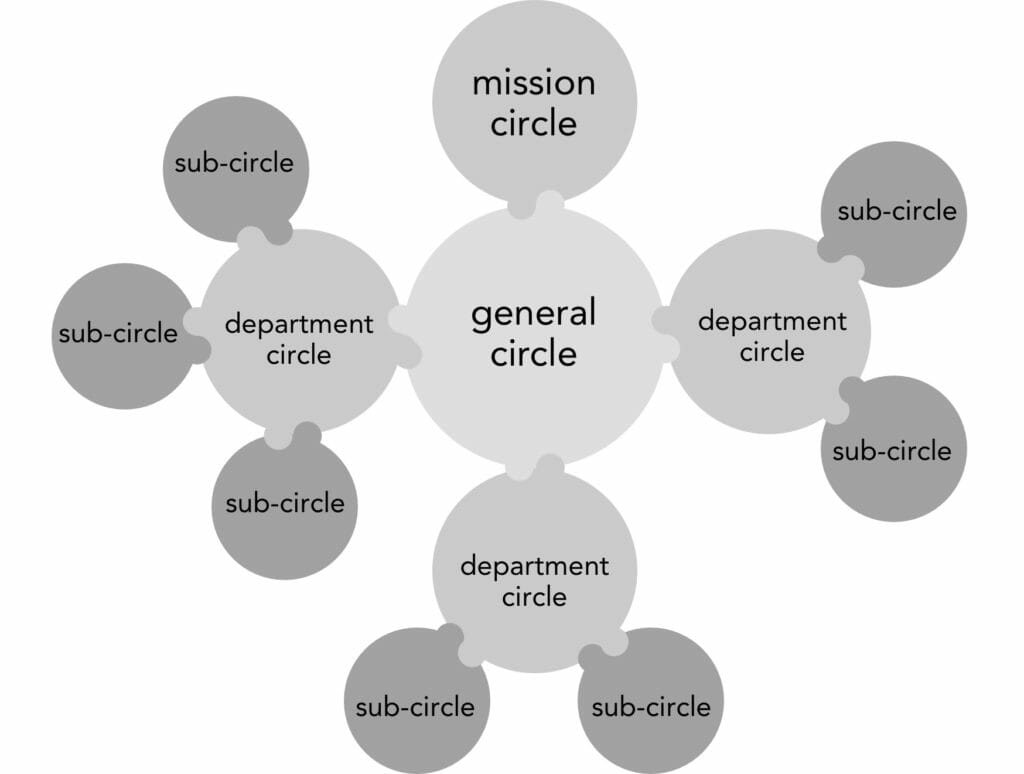
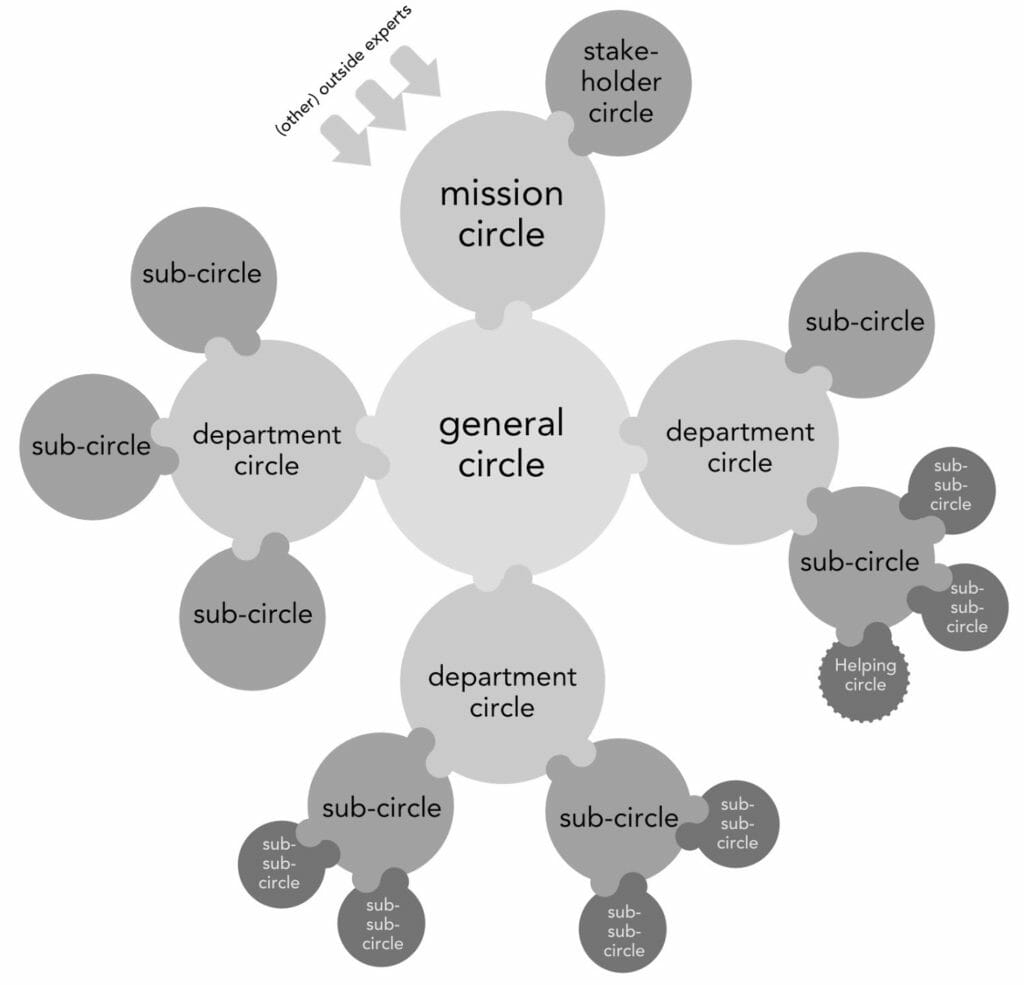
- A standing circle (subcircle) takes on an ongoing area of work — a “domain.”
- A helping circle is a temporary group formed for one specific task, like turning information into a one-page document.
Another useful move for recurring issues is creating a role — not just facilitator, leader, or secretary, but roles like “the person who responds to emails on X topic” or “the person who handles membership inquiries.” If you look back through old agendas, you’ll often find the same topics keep recurring. Once the group has agreed on a standpoint, you can hand that topic to a role, and only unclear or new cases come back to the circle.
Example: In my co-housing community, we closed our common house during COVID and set up a booking system. I hold the role of scheduler — people text or email me, and I take care of routine requests myself. Only requests outside the existing policy (like an unusual gathering) come back to the circle. Twenty routine requests between meetings never take up circle time at all.
Clarity: Reports, Explorations, and Decisions
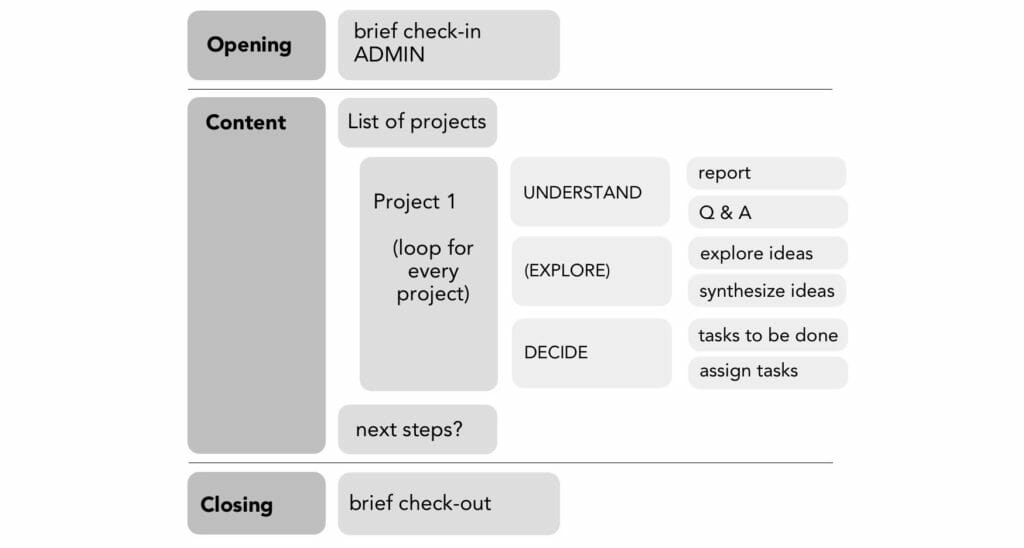
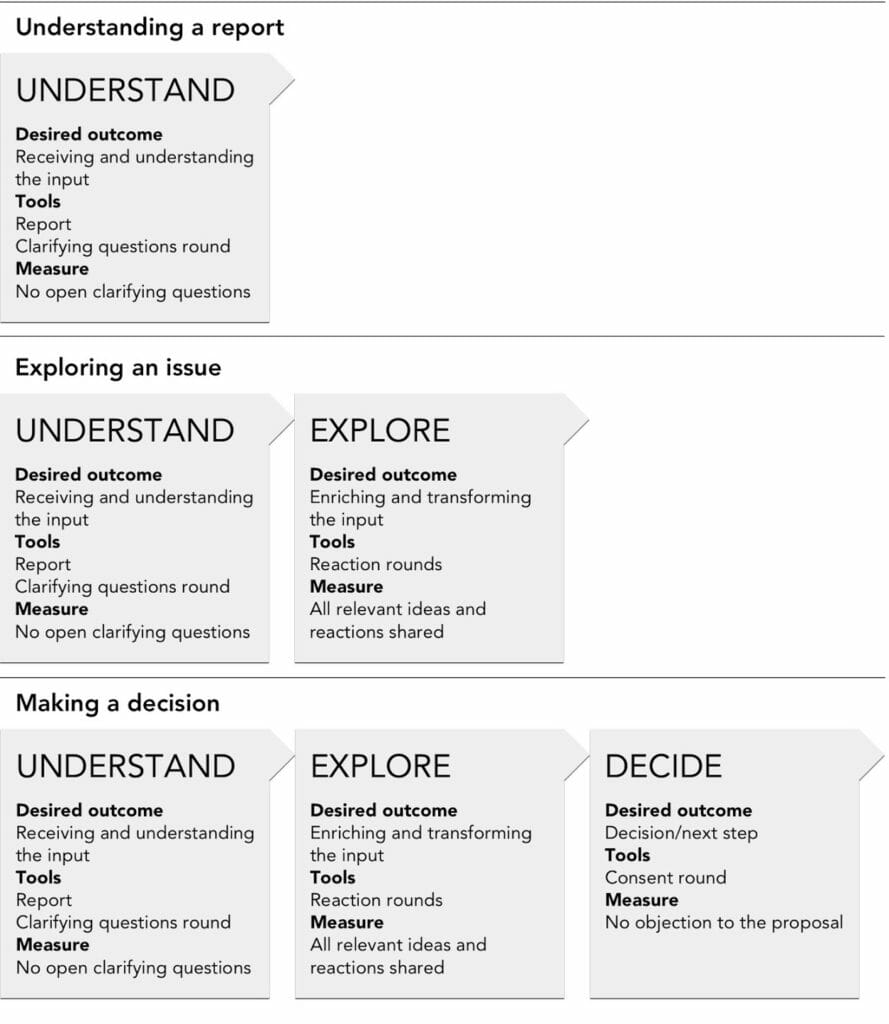
This is my personal favorite for improving time management in meetings, because clarity goes a long way. Every agenda item in a meeting is one of three things:
- Report — someone is sharing information; all the group needs to do is receive it. No discussion needed. (I personally don’t like meetings where reports take up more than a quarter of the time — if it’s pure information, send it by email instead.)
- Exploration — the group bounces ideas, gives feedback, or discusses a question, ideally speaking one by one in rounds. Nothing has to follow from it.
- Decision — the group has a proposal, makes sure everyone understands it, hears reactions, and then approves it.
Knowing which one an agenda item is tells everyone exactly what to expect — including how long it should take (a report might take five minutes, an exploration fifteen, a decision depends on how well-prepared it is). It also prevents disappointment: if half the group thinks today is a decision and half thinks it’s just an exploration, tension is almost guaranteed.
This clarity also helps people contribute more efficiently. If someone doesn’t know what’s being asked of them, they tend to give a stream of consciousness — which eats time. Instead, tell people specifically what you want: “Give me your reaction to this thought — only that, not everything else we could be talking about.”
Building the Agenda
Once you know the difference between reports, explorations, and decisions, you can build a consistent agenda template. In our sociocratic meetings, the format is always the same: roughly seven minutes for an opening round, then the agenda items (each labeled R, E, or D), consenting to the agenda, and a closing round. The structure stays fixed; only the content changes.
This isn’t about micromanaging every second — it can be flexible and natural in tone. The important thing is having clarity in your own head about what you’re doing in each moment, so you know what your “finish line” looks like (for a report: everyone understands; for a decision: consent is reached).
Consenting to the Agenda
This is another key lever for better time management in meetings. At the start of the meeting, show people the proposed agenda — the topics, the time allotted, and the intended outcome — and ask: is this how you want to spend our time? Get a yes from every person in the group.
This matters because it turns the agenda into a shared agreement, not just something in the facilitator’s head. Without an explicit agreement, it’s very hard to hold people accountable — and if you try to hold people accountable to an agreement you made unilaterally, it will always feel like something being imposed on them.
When things go over time. Sometimes a 15-minute item takes 30, because something got more complicated or new information came up — without blame, that just happens. When you notice you’re going over, the move is to renegotiate: name that you’re running out of time, propose how to handle it (extend this item and drop something else, for example), and get consent to the new agreement. It’s not about rigidly sticking to the plan — it’s about staying clear and intentional, moment to moment, and flagging when a shift is needed.
Other ways to reclaim time when you’re running over:
- Have one person (or the original proposer) make the final call instead of discussing further as a group.
- Assign a follow-up — someone prepares something or sends an email after the meeting.
- Postpone an agenda item — but only by consent, since you can’t unilaterally drop something the group already agreed to discuss.
These renegotiation conversations can themselves take time, which feels counterintuitive and sometimes excruciating in the moment. But it’s worth it: the signal it sends, again and again, is that the facilitator isn’t solely responsible for saving everyone — the whole group is accountable to the agreement they made together.
Encouraging Proposals
Something I wish I could whisper into people’s ears when I observe meetings: make a proposal, please — and a little earlier than you think you should. Without a proposal on the table, people are just meandering, and no one has anything concrete to say yes or no to. A proposal is a request: “Given what I’ve heard, how about this?” People can always say no — that’s the point of consent — but at least there’s something to respond to. Getting to specific results is a key driver to improve time management in meetings.
A useful structure: two rounds of input (typically that’s plenty — more rounds rarely add much), then someone makes a proposal. That alone saves a lot of time.
The consent process, as a refresher, is three steps:
- Clarifying questions to make sure everyone understands the proposal.
- Reactions (quick reactions) to the proposal.
- A consent round — consent or object.
Redirecting Off-Topic Contributions
When someone goes off track, or keeps talking well past their turn, the goal is to validate and redirect — not to shut them down. For example: “What you’re saying is important. Let’s make sure to leave time for others to ask their questions too.”This validates both the person speaking and the group’s shared need for time — stated in the positive, which carries much less blame and shame than the negative version (“that’s not what we’re doing right now, and we’re going to run out of time”).
If someone is talking on and on during a consent round and you’re not sure whether they’re consenting or objecting, it’s fine to gently interrupt: “Hold on — here’s the question for you,” and reiterate what you’re actually asking. That comes from curiosity, not dismissal — you’re saying “I care whether you consent, I just don’t know yet.”
For a new topic that comes up outside the scope of the meeting: “This seems outside what we planned for today. I definitely want to talk about it — let’s put it on the backlog.” This says yes to the group’s frame for today and yes to the person’s topic, by making sure there will be time for it later.
Counter-Proposals
A pattern I see constantly: someone is asked “do you consent to the proposal?” and responds with “I have a different idea — let’s do this instead.” This is tricky because it doesn’t actually answer the question being asked (consent or object) — it introduces something outside the process entirely, and groups often get stuck, unsure what to do next.
Two easier ways to handle it, instead of dropping the original proposal:
- Consent first, then add. If the new idea isn’t a dealbreaker, ask: “If you don’t object, can we consent to the original proposal, and then look at your idea separately?” This often works well for small additions.
- Full restart. If the new idea is completely different from the current proposal, you may need to drop the original proposal and start fresh with the new one. This is real backtracking and can feel frustrating — which is why I’m not a fan of counter-proposals as a default move.
The Backlog
The backlog is a running list — a “parking lot” — for topics that come up but don’t fit into the current meeting. It stays in place between meetings (a group might meet monthly, then work for four weeks, then meet again), and its contents feed future agendas.
Items get added to the backlog both during meetings (when something comes up that doesn’t fit the current discussion) and during work between meetings (for example, in my common-house scheduler role, if someone asks a policy question I can’t answer, I add it to the circle’s backlog). The backlog keeps a group from chasing every new idea the moment it comes up — while making sure good ideas aren’t lost, since accountability ensures the group circles back to them. Time management in meetings improves if we can focus!
Honesty
This one is short, because it’s simple to say: be honest in your meeting evaluations. If meetings are running over, or time management isn’t working the way you want, say so at the end of the meeting. Whether you speak up is your judgment call — but if you don’t, nothing is likely to change. Staying silent means colluding in a meeting culture you don’t actually like.
Speaking up is a responsibility we share, and better time management in meetings is therefore also a shared responsibility. It might not fix the first meeting, or the second — but over time, meetings genuinely improve. A few examples of things worth saying out loud:
- “I think we should form a subcircle for this.”
- “I think we should introduce timers.”
- “I think we should start on time.”
- “I think our meetings aren’t well prepared.”
- “I think we need a shared evaluation of how our meetings are going.”
On timers: I sometimes run a visible timer as my Zoom background — it’s a simple way to stick to agreed time limits for things like check-ins, since you get real-time feedback on how time is running.
A question to leave you with: If someone is talking for a long time, how would you like the facilitator to intervene? Ask your group this directly. Something like: “I sometimes find it hard to interrupt people when they talk for a long time, and it makes our meetings run long. Let’s agree on what I should do in that situation.” That way, the facilitator isn’t playing “bad cop” — they’re holding the group accountable to an agreement the group itself made, which feels very different from being told to stop talking with no agreement behind it.
Curious about sociocracy in general?





Leave a Reply
You must be logged in to post a comment.